Intro | Background | Observations | Benefits & Challenges | Getting Started | More Getting Started | Applying it to a Song
Now let’s try some exercises such as the following, which are simply four-finger equivalents of some well-known three-finger rolls; the forward roll, backward roll, reverse roll and a couple of variations of the alternating thumb roll. (Note: This terminology is referenced from the names of rolls as found in Earl Scruggs’s book). Practice these as being phase I of your studies in 4-finger playing. Just as when you were learning your three-finger rolls as a beginner, practice these literally at least 500 times. 1000 for each roll would be even better!
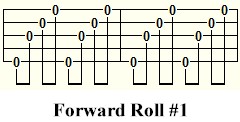
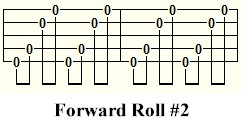
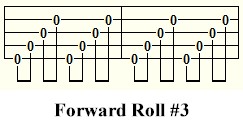
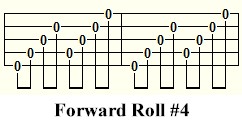
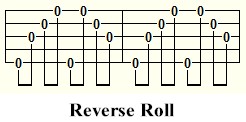
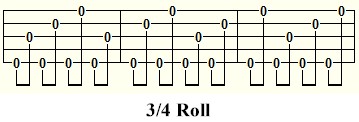
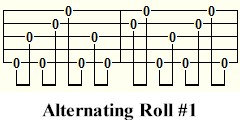
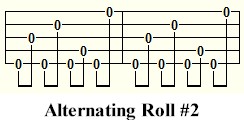
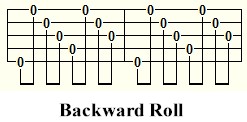
One thing you’ll quickly notice in doing these exercises is that the ring finger simply cannot be lifted as high above the banjo bridge as other fingers! Perhaps some folks can do this, but I don’t think many people will find it an easy task to get much lift above the bridge with the ring finger. You’ll also soon see why this is important; the ring finger, now a picking finger, comes quite close to the first string, more so than any other finger. You wouldn’t want this finger to get lazy and occasionally hit the first string, especially if you’re not using the ring finger for a bit and it’s just sort of hanging there waiting for another four-finger roll to come along. One solution to this is to use a higher overall hand position. That’s a bit tougher for me, as my right hand position is pretty low to start with.
Because of this inability of the ring finger to get very high, the backward roll (the last one presented on this page) is an especially difficult one to do.
The next phase, which you can do concurrently with the rolls if you like, is to find good fretting positions to match these new roll patterns. At first, this simply means to do the rolls with various chords you already know. Later, though, this means to re-engineer some of you left-hand techniques; slides, hammer-ons and pull-offs, for instance. Start with left-hand techniques that go well with alternating thumb patterns, since they are already based on 4 notes, as opposed to three notes as with forward and backward rolls.
Create a new lick or two using this process and try this on one of your slower songs. Keep on working at it and see how it starts to sound once you start getting a moderate amount of speed to it (maybe 5 or 6 notes per second). Do you like the sound of it? If so, I suspect it’s worth pursuing!
Of course, you realize this is going to take some time. Remember how much effort you had to put into learning three-finger style? Well, this is no different – you’ll need to go find your initial enthusiasm once again to do your best at this, just as you did with three-finger. Be persistent. And don’t overkill with it. Remember to keep three-finger Scruggs as the ‘glue’ to bind everything else together and I believe it will be most effective.


 Phill Gibson
Pingback: Playing Banjo 4-Finger Style – Background
Pingback: Playing Banjo 4-Finger Style – Some Observations
These instructional blogs are a Godsend! I’ve been looking for info on 4-finger banjo picking for months so this is like the land of milk and honey. I’ve been playing banjo since I was 15 about 7 years now and I can’t wait to take on this challenge. What format are the roll examples in? It seems when I click on the link there’s an error. Have they been taken down? If you have any books or other material on this stuff, sign me up!
Hi Molly Mae,
Sorry to take so long replying! But I’m back! 🙂
Many folks have written about 4-finger style banjo. There’s hardly anything out there about this,mainly because almosr nobody plays this way! I do have some new ideas I’llblog about soon; more variations on 4F style. And some better ways to apply it that I’ve thought of!
Yes, I had to find a new blog host, and I still need to get the images llinks fixed; all the text seems okay, but images and tab…still need a little work, I see. Will do that soon!
Thanks for the post!
I would also like to see the four finger rolls. I am just starting to learn the banjo.. played some finger style on guitar using four fingers so it seems more natural to me. Would be very interested in practicing some of the rolls.
Thank you
Hi Daniel,
I got those 4-finger roll diagrams back up again!
Thanks,
Phill
Thank you very much.. I got them printed off so I can practice them.
Daniel
Thank you so much for blogging about the 4-Finger Style. I’m about to
embark on learning the banjo and have been wanting to leverage my
Classical Guitar skills (3 fingers plus an anchor feels really
odd) — now I know it’s possible.