Connecting to Your Roots

Where do you come from? I don’t mean literally where do you reside, as in your city, state or country. I mean that more nebulous quality that includes how you were raised, what ideals you value and how you relate to your neighbor. Musically, that’s important as it defines your life experiences, from which you’ll get a lot of how you express yourself. That’s really where you are coming from.

Traditional music, in all its varied forms – be it bluegrass, old-time, Celtic, folk, new acoustic, blues – places a high value on sticking to our roots. As a matter of fact, I think one of the main differentiating factors between modern rock and traditional music is just that – whether you embrace or leave behind the traditional values you are/were associated with. Just listen to some of the various themes presented in either rock or traditional music and you’ll see that trend. One of these days, I plan to blog on just what it means to be a bluegrass song, and a big part of that is how the song treats roots.

Rock has indeed borrowed very heavily from its own musical roots in traditional music; an ironic twist if ever there was (keeping musical roots versus discarding traditional roots). Combined with this to form rock music are the rhythms of jazz – that first inkling within musical genres that perhaps there was something beyond tradition to explore. That was an overarching theme to music in the early 20th century as traditional music gradually became to share space with new ideas; it could all be summarized by the question: ‘What shall we do with our roots?’

This leads me to an overall observation; see if you agree. Blues and Jazz separate over how to treat their roots; blues embracing them, jazz discarding them, just as bluegrass and rock part over roots in exactly the same way. 

What thinkest thou?

Posted in Banjos and Society, History | Leave a comment

Who's the Best?

When I was a Boy Scout years ago, we used to sing marching songs while out hiking. That was a lot of fun. One particular thing we did was this shout: the Scoutmaster would shout “Who’s the Best!?” And we would all respond enthusiastically “We’re the Best, 355!” (We were Troup 355).

But who’s the best musician? I usually don’t think in terms of ‘bestness’. To me, it’s more about having fun, setting and achieving goals, and satisfying that artist urge in each of us that makes music a good endeavor.

But we also have this urge to compete, all of us, to some extent. That’s one reason there is the Tennessee Valley Old Time Fiddlers’ Convention in Athens, AL each Fall. To see who’s the best Fiddler, Banjo picker, Harmonica blower, etc.

But you’ll notice there is no quantitative method to determine who’s the best. It’s up to a subjective panel of judges. You can have the best technical performance, but if you choose the wrong style or wrong song for those judges, then you’ll not rank as highly.

But that’s the best we can do in such matters.

For beginning musicians, it’s not so hard to determine how good you are. It’s pretty obvious how you are progressing. But as we improve, it’s like we come closer and closer to achieving that absolute state of perfection (not that we ever get there, mind you). And so measuring our progress becomes more complex.

We could measure it by how many songs we know, but that also breaks down when we realize that some many parts of songs are easily interchangeable.

How about measuring it by how many licks you know? That’s a bit more to the point, but doing so would only increase the complexity of measurement. Besides, it’s also how cleanly you play those licks.

Measuring speed? That’s certainly quantifiable, but it leaves us with a hollow victory, as we easily recognize so many other attributes are needed for ‘bestness’.

You see, this is not like sports, where you can reasonably quantify the best. Music is an art, and as such, it is simply the opposite of any measurement of quantity – it is, by its very essence a quality, not a quantity. That’s what makes it what it is.

Ultimately I think, no, I feel, it is more likely “who’s been best at being in the right place at the right time and been bold enough to seize the opportunity, assuming due diligence in needed practice”. What a mouthful. This also may make them more inspired (I know it does for me); a very visible attribute. And that is about as close as we can get to measuring “bestness”.

So we grab it and run.

Bottom line: just keep practicing, and enjoy it – you never know where your music will lead you.

Posted in Philosophical Ramblings | Leave a comment

What I'm Currently Listening To

A brief look at what I’m currently listening too. 

Count Basie – Taxi War Dance. The Count was popular in Jazz back in the 30s through the 50s and his swing-style music continues to inspire enthusiasts today. I love the rhythm section in Count Basie’s big band and their newly developed style of using the high hat for establishing the beat – it opened up many new possibilities for the lead instruments. Listen sometimes to ‘Taxi War Dance’, or ‘Swingin’ the Blues’, for instance. 

The Dixieland Allstars – When the Saints Go Marching In. The old standard, you must think of New Orleans when you hear this tune. The chords are quite simple, but it’s what the lead, back up and rhythm instruments do in a typical jazz context like this that makes the song work. Listen to it sometimes and see what lessons are there for a bluegrass band. 

Tony Trischka and Alison Brown – Arcadia. This is from Tony’s very successful bluegrass CD ‘Double Banjo Bluegrass Spectacular’, in which Tony collaborates with many top Bluegrass talents on the songs. Very similar to what Carlos Santana did with his monumentally successful CD ‘Supernatural’; collaboration proved a successful tool for both these musicians at least in part because they at the top of their game, so to speak. I don’t think such collaboration would work for just anyone. Tony and Alison’s styles are very similar in many aspects, but you can pick out who’s playing if you listen closely or if you already know their styles. I’ll have more to write about Alison’s music in a forthcoming blog. 

Candy Dulfer – Lily was Here. I just have to admit it – I love a lot of songs simply for the groove that lays a foundation for the rest of the song, and this is one of them. It’s almost like a jazz version of ‘Dueling Banjos’ (‘Dueling Guitar and Sax’?) that works so well in showcasing those sophisticated licks. 

Carlos Santana – Samba Pa Ti. I’ve been listening to this since, oh, 1969. I think I know every single note in the original version. A classic in every sense of the word. 

Dave Grusin – Mountain Dance. Here’s another tune that just amazes me. Listen to the chords, the melodies and the changing rhythms! How did Dave put them all together so effectively, I want to know.

Posted in Music in General | Leave a comment

Bringing Out the Best

One of my banjo pickin’ buddies and I were talking a while back and the discussion turned to musical goals. I mentioned some of mine: things like wanting to explore more jazz, record a CD and the like.

In turn, he mentioned but one goal: to be able to bring out the best in any banjo.

A rather simple task on the surface, you might think. But let’s look closer and you’ll see what a grand and demanding goal, indeed!

On the most visible level, to bring out the best in any banjo means to be able to play any style. This includes Scruggs, melodic, Reno, clawhammer in its’ many Varieties. And what about 4-string banjos? Tenor and plectrum banjo, played with a flatpick, demand their own styles which vary with Dixieland, Irish and Celtic, among others. Add those to the grocery list.

Don’t forget the various tunings as well. Even though open G is the most prevalent, clawhammer especially uses several different tunings.

You must know what all kinds of banjos there are. And there are plenty. What do players normally do with a piccolo banjo or a mando-banjo? Is this banjo set up for bluegrass and if so, is it set up properly?

Does the banjo have historical significance? How would you play a banjo that had belonged to, say, Stringbean, or Don Reno, as opposed to Earl Scruggs? They were contemporaries, but you must know their history.

Furthermore, to play any banjo to its’ fullest capability means you have to have a very keen ear for what any banjo really sounds like. There are beginners’ banjos and top-of-the line pre-war Gibsons. There are also banjos set up for hard-driving bluegrass or for quiet mountain ballads. Skin heads and plastic heads, tone rings and resonator wood choices. Each of these will influence what that banjo sounds best for, according to our generally-agreed-upon set of standards. (bright and loud equals bluegrass, skin heads equals clawhammer, etc.). These rules can be broken, but you must well know the rule before you break it!

Lastly, to bring out the best in any banjo means you have to have a repertoire large enough to accommodate each style. Some songs just fit more naturally in one genre than another, but other gems also await our discovery in porting them into another style. Remember ‘Love Hurts’, written by Boudleaux and Felice Bryant, of ‘Rocky Top’ fame? The rock group Nazareth recognized this songs’ potential for them and reaped the rewards for their discovery. So it is with choosing which song to play in what genre.

Now, the grocery list is quite lengthy!

In a nutshell, if you want to bring out the best in any banjo, you have to balance playing style, history, instrument quality, kind and sound, be familiar with the body of songs in that genre and know when you can bend or break the rules.

Quite an undertaking, but what fun the journey can be, if you’ll just let it be!

Posted in Philosophical Ramblings | Leave a comment

Slide-out, Switch-in

As I’ve taught students the basics of chords and their positions on the banjo fret board, I’ve continued to marvel at the various symmetries and relationships that pop up.

For instance, Let’s look at the D and F chord positions and one interesting relationship they share between both major and 7th chords.

I suspect almost any banjo player could rattle these off quickly, but as a quick review here are three basic chord positions. With these, you can make any major chord:

  • The Bar chord
  • The F position
  • The D position

The D and F positions are so named from the first chord students usually make with them.

By flatting or sharping one or two strings, you can also modify any of these chord positions into a minor, 6th chord or 7th chord.

Notice, since we are dealing with four strings here (yes, we are ignoring the fifth string as we talk about chords) and since we have four available fingers to fret with, we have an ideal situation with the banjo fret board: almost every chord we make can be a closed, slidable chord. That is, we can use this particular finger position to form any chord: G, G#, A, A#, etc.

Based on these relationships, here are a few of the gems I often share concerning banjo fret board logic.

1.       Want to turn a major chord into a minor chord, and always remember how? Just remember that all you have to do is flat one note one fret. In other words, just move one of your four fingers one fret towards the peghead. But which finger? That depends on which of the three basic chord positions you are fretting.

a.       For the bar chord position, flat the 2nd, or B string.

b.      For the D position, flat the D string. Oops – but there are two D strings! So flat them both; the 1st and the 4th strings (it’s still one note being flatted).

c.       For the F position, flat the G (the middle or 3rd) string.

You’ll find very quickly that you have to rearrange all your fingers for the Bar position. The F position also takes some getting used to, and the D position is the easiest of the three to fret.

2.       Want to make 6th and 7th chords quickly? Just as we flatted one string for a minor, we sharp one note up two frets for a 6th chord, and up three frets for a 7th chord. Just like going from major to minor, this also depends on which of the three basic chord positions you have.

a.       For the bar chord position, sharp the 1st, or D string, up 2 or 3 frets. Don’t bother with the 4th string, even though it is also a D string. This one is fairly easy to fret.

b.      For the D position, flat the G (i.e., 3rd) string up 2 or 3 frets. Notice this is the string with the finger closest to the peghead.

c.       For the F position, flat the 2nd, or B string up 2 or 3 frets. Just as withthe D position, this is also the string with the finger closest to the peghead.

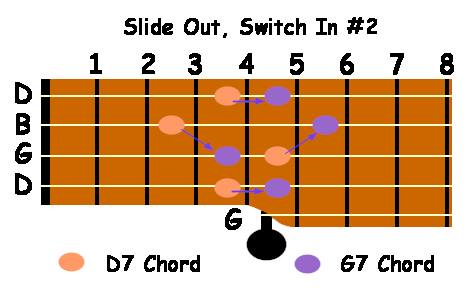
3.       Now, hang with me just a little longer and do this. Go back a forth between the F and D position for both the major and 7th chords. Do you notice any similarities? See how the outer two strings (1st and 4th) just slide up or down one fret when you change from major to either minor or 7th, and how the inner two strings (2nd and 3rd) just switch fingers? And this holds true for all situations: minor, 6th and 7th chords.
I call this ‘Slide-out, Switch-in’. Meaning, slide your two outer strings up or down a fret and switch fingers on the inner two strings. Once you get the hang of it, it makes it a lot easier to remember these various chord changes.

Here’s a couple of diagrams that will also help explain this concept better:

Slide Out, Switch In, 1 

Slide Out, Switch In 2
More fret board logic later.

Posted in Tips & Techniques | Leave a comment

What's Required to Learn the Banjo

I’ve had folks ask me before “Isn’t the banjo one of the hardest instruments to learn to play?” Others have expressed exactly the opposite viewpoint. I don’t think of the banjo in those terms. I think of it as equally difficult or easy as you would care to make any other instrument. True, it’s not as easy as our usual concept of, say, an ocarina. But you could take most any simple instrument and apply a most difficult regiment of techniques to it, thus turning it into a difficult-to-learn instrument.

So what we are really addressing when we ask “Is that a difficult instrument to learn?” is whether the customary style of playing is easily mastered or not. “Is that a difficult style?” is a more appropriate question.

You see, learning to play the banjo is just like anything else in life that is not dead easy. It takes first and foremost a desire to achieve the goal. Desire trumps just about any obstacle you can name. If you have it, you will succeed. If you don’t, then you will fail. Simple as that. (Yes, for the pessimist out there, I must admit there are cases where no amount of desire is going to change things, but they are by far the exception; don’t let them become the majority).

It also involves some common misconceptions about what else is required, what is optional and what is really detrimental.

What is Required

  • Desire. As I’ve mentioned above, the number one requirement in my book is desire.
  • Practice. This is also well-travelled ground when it comes to advise for anything. Perfect practice makes perfect.
  • Time. Isn’t this what practice is about? Yes, but here I mean it will be a long-term project, not something accomplished simply by a lot of practice, as essential as that is. You’ll need to be able to reflect on what is going on. To let you fingers assimilate all the licks you are learning so that they can do it as naturally as breathing. By the time you are an expert, you’ll literally be able to do an alternating roll while you think totally about something else. You can see that this will simply take some time.
  • Rhythm & Timing. But do we start out with this? Not necessarily. I believe most people have rhythm and timing, or else, with very few exceptions, we can cultivate it. I remember I started out not having very good timing when I was playing with others, and I didn’t even realize it. I figured it out and concluded that it was me, not everyone else, that was speeding up and slowing down. With a little effort and a metronome, I overcame it.

What is Optional

  • A quiet country place with a front porch. I’ll admit, that is where I did a lot of my learning. But I also did a lot of learning early on in a crowded dormitory at college. Sometimes I think it’s a wonder I didn’t get killed. Truth is, not only did I not get killed, many of us in the dorm had a great time practicing together!
  • Plenty of instructional materials. I have a lot of banjo tab books and such. As a teacher, I do get a lot of good ideas that are valuable, but as a learning student, you shouldn’t lean too heavily on tablature alone. Experimenting is of great benefit; it’s like actually sitting down and doing something, which is the best way of learning anything, as opposed to reading about it only. It also develops improvisational skills as you learn your way around the fretboard better by just trying new things.
  • A fancy banjo, sophisticated tuners, etc. Most folks learn on a beginners banjo. You can spot them a mile away; they all sounds the same and look just about the same. Same machined flange, same shape to the neck. The name on the peghead changes, but that’s about it. Don’t get me wrong – since these are what most folks learn on, there has to be some abiding virtue to them, and there is. They are playable and sound decent enough to get the job done.
  • A lot of talent. Talent certainly doesn’t hurt, in and of itself. Remember the old adage about wasted talent, though, because it’s true. Sometimes a lot of talent can go to a person’s head. At that point it isn’t helping you do anything in the grand scheme of things.

What is detrimental

  • A too-busy schedule. This means not enough time, which means not enough practice.
  • Distractions. This mean ineffective practice.
  • I want to learn it all – now”. This goes back to what is required – time. You can never learn it all, but what you can learn will take exactly the rest of you life. Enjoy it but especially, enjoy the journey!
Posted in Beginning Banjo | Leave a comment

Defining Your Own Style

As a web developer by day, I often work with something called cascading style sheets, or CSS for short. On a web page, this is where you put all of you ‘look and feel’ properties for a web page, or even for the entire website. We banjo players also have our own styles. Not embedded in a modular little component, but rather, expressed throughout and integrated into every musical movement we produce. It really says who we are as musicians as few other attributes do.

I don’t know of anyone beyond a beginning level who would like to sound exactly like someone else. The closest we usually come to this is trying to sounds just like Earl Scruggs, a fairly common notion when we first start playing the banjo. Soon we realize that that impressive Scruggs sounds isn’t so much linked just to Earl’s style alone, but is found in a myriad of other players styles, thus opening a world of possibilities. I remember when that dawned upon me as a beginner and it felt really great to know that there was even more out there that needed to be learned. Not only just other styles, as in melodic, Reno, clawhammer and such, but also nuances within Scruggs style alone.

Take a pull-off for example. You could do a basic pull-off, or you could do a double pull-off. I like those double pull-offs; they’re very distinctive and they’re not heard all that often. J. D. Crowe does them some, so when I hear an unknown banjo, and a double pull-off comes along, I immediately wonder ‘Is that J. D. Crowe?’

That’s a good long-term goal to be able to develop your own style to the extent that a knowledgeable person could figure out that it’s you playing the banjo and not someone else. We can define our style by listening to and trying out a large number of different techniques and licks. Some we’ll ditch and others we’ll keep and integrate into our songs.

Where do we get these various musical motifs to test? Some we’ll get from fellow musicians, some from tablature. There are indeed whole books of just banjo licks to try out! But I think the best of all is when you create your own licks. Nothing says individual style as much as your own creations.

One last thing. Don’t expect style to develop overnight. This is a long-term goal. You have to be able to step back and reflect on where you are going musically in order to decide ‘Is this what I really want to do in musical expression?’ And that takes a lot of time. The fun part, though, is in exploring all the possibilities and finding that occasional gem that you can call your very own.

Posted in Tips & Techniques | 1 Comment

Banjos and Stereotypes

Sometime back, I saw a commercial on TV for for a certain SUV. You must know – I rarely watch TV, so I wonder how much of this is in commercials. Seems these young guys had pushed their SUV to its trail blazing limits and had wound up almost at the red-necky point of no return. How did they know this? Somewhere in this deepest, darkest part of Dixie, they came upon a hayseed; starring, mouth agape, with banjo in arms. He must have had more frets than IQ. The young guys found this scarier than Norman Bates and high-tailed it out of there.


Of course, the take-home from this is that we should all have better sense than to find ourselves near banjos – the very harbingers of all that is bad in the country. But, if you really wanted to be able to get that far back, then get yourself a SUV!


This reminds me of my own experience in banjo stereotypes.

When I was first learning to play the banjo, I would often sit outside and practice near the road. We lived on Green Mountain, which had newly been annexed into the Huntsville, Alabama city limits. Even though it was within the city limits, it was still very rural in character. Whip-poor-wills would sing in the spring and the stars were still so bright. It’s still the nearest place you can really get away from the city without going very far.

Anyway, I would sit in the bench swing under the old pine tree up near the road. Drivers in their cars would come near, but they really couldn’t see you very well unless they knew just where to look. One chilly fall night around 1977, not long after I first learned ‘dueling banjos’, a couple came to this backwoods spot and parked up at the power line about 100 yards away. I could tell it was two people, because two doors slammed; they had gotten out to go enjoy the scenic view (we lived right at the edge of the mountain, with a spectacular view to the east).


“Hmmm… I wonder what they would think of the local population if I started playing my latest song?”


I proceeded to play ‘dueling banjos’. They promptly got in the car and drove away! I can only guess I scared them into thinking they were a little too close to needing their own deliverance from a banjo-toting Norman Bates.


And they didn’t even get to hear that fancy ending I worked on so hard!

Posted in Banjos and Society | Leave a comment

How’s Lessons?

Frequently, someone asks me how teaching banjo lessons is going. I always tell them it is great. And it is: I have just about a full schedule now (I only teach on Tuesdays and Thursdays after work) with a great bunch of students. It’s very uplifting to be put on the spot for what to cover at each upcoming lesson.

I also have discovered several unexpected benefits of teaching music. One is when you start seeing patterns of successes and patterns of difficulties across many students. For instance, Almost everyone has had questions on playing the break to ‘The Ballad of Jed Clampett’ when they get to the first measure of D in Earl’s tablature. To be aware of these is to be able to more readily address them.

Also, I can now lump most people into one of three categories: those that have initial difficulty doing D position chords, those that have initial difficulty doing F postion chords and those that just breeze through them all. Of course, some have initial difficulty with both D and F but eventually, they seem to have conquered one or the other first.

Among the successes is the satisfaction I have when a student starts showing progress and really gets interested in practicing. At that point they can learn so much! And it mainly has to do with their interest; get keenly interested in something and you’ll overcome a host of roadblocks.

I tell everyone I plan to teach full-time when I retire. Perhaps I’ll add Mandolin, Dulcimer and Bluegrass Guitar to my classes, but who knows when that day will come. I look forward to it, though.

Posted in Teaching | Leave a comment

Banjos and Selective Memories

Those good ‘ol school days. Remember them?If you’re my age (51), then perhaps you’ll agree; those were the days! But if you’re still in school though, you may say “the good ‘ol days” is looking through rose-colored glasses. I’ll admit that does gloss over the reality of life. Forget all the homework, bullies and easily available vices, and you have a far more perfect world for fond rememberances.My perceptions then and now have certainly changed. People are like that; we tend to forget the bad and remember the good, given enough time from the situation. Perhaps we especially hold dear those places and times we have experienced and are no longer a part of.Our perceptions of banjos in society are another good example (you knew I’d work a banjo in here somehow, didn’t you). We remember the banjo as a care-free instrument partly because the banjo has, since it’s arrival on America’s shores, been relegated to the wrong side of the tracks. A red-headed step-child of more refined musical instruments. But along with that stigma comes a blessing in disguise; to be down and out also means few expectations. For someone used to the demands of a hectic and stressful life, this can be very freeing. And so, we remember the good and leave the bad. Banjos have long represented something less than ideal to many, yet few would argue against the fact that they also represent among the purest of modern ideals of happiness, simplicity and carefree living. May that always be so.

Sing banjo, sing!
Sing out o’er the world.
Tell everyone to love
Tell every boy and girl.

Ring banjo, ring!
Sing out o’er the land.
We’ll build a better world
If together we will stand.

‘Sing Banjo Sing’
by Eddie Adcock

Posted in Banjos and Society | Leave a comment