Recently, a student and I were looking to play Reuben, traditionally played in D tuning (F# D F# A D on a standard-sized banjo). However, we ran into a bit more complexity than expected as we both were playing on a Gold Tone Cripple Creek Mini banjo.
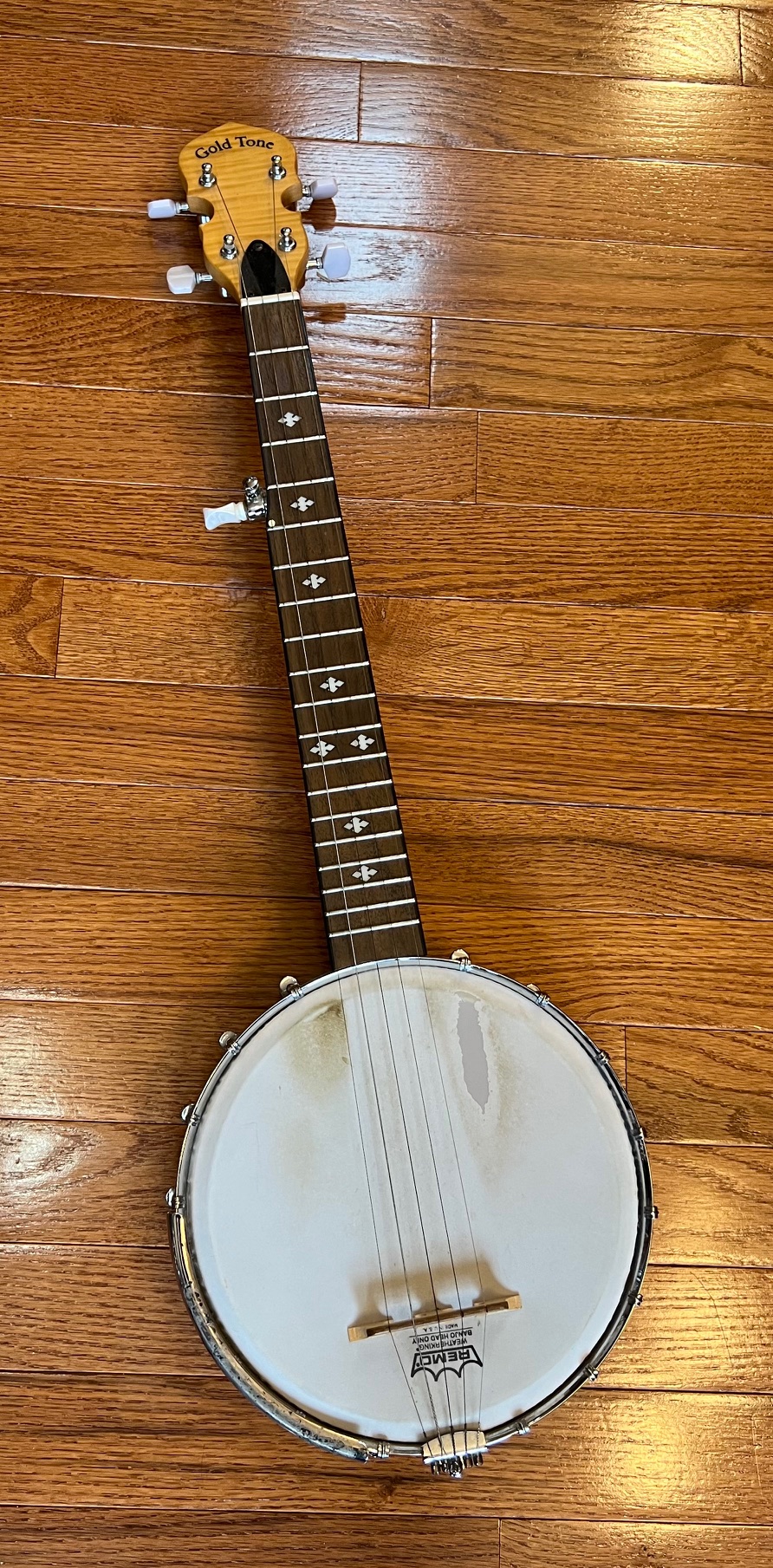
I really like my Cripple Creek Mini. It is a very compact instrument that is very good to travel with. I put mine in a backpack but the peghead and three or four frets still stick out the top. Once, I had a TSA agent at the DFW airport ask me to take it out and play him a song! I took it out, quickly tuned it and asked what he would like me to play. “Dueling Banjos” was his command, so off we went with that well-known song! (the abbreviated version, as folks were still wanting to get through the security lines, Deliverance notwithstanding!)
Anyway, not always obvious as you play an instrument with a shorter fretboard (the Cripple Creek Mini is 20″ from nut to bridge, standard banjos are 26 1/4″) is the fact that notes are 5 frets higher. What plays like open G tuning is in fact open C tuning. Not to be confused with C tuning or Mountain Tuning used in some old-time songs.
So how do you tune a short banjo to D tuning?
You can get very wrapped around the axle if you think about this in the wrong way. Just remember; each string on this shorter fretboard is now 5 frets higher. For example, if you look at standard open G tuning (G D G B D), that translates into C G C E G on the Mini.
Forgot how to translate it? Just remember the chromatic scale: G G# A A# B C C# D D# E F F# G and count up 5 notes (five frets). So for example, G translates to C because we count up five steps on the chromatic scale.
Ok, so D tuning on a standard banjo, as mentioned above is F# D F# A D, so translating up five frets would be B G B D G. If you are using an electronic tuner, those are the notes to tune to on a short banjo like the Cripple Creek Mini.
Also, remember, the first note in this format is the fifth string, the short string , or the string nearest to your eyes as you are holding the banjo.
One more tidbit that can trip you up in thinking through this: in D tuning on a standard banjo, you have to capo up two frets from the fifth fret. On my Cripple Creek Mini I don’t have any “railroad spikes” to capo my fifth string, so I just tune it up two frets. It’s a bit tight, but it works. I wouldn’t want to tune it much further without using a capo, though, lest I break a string because it’s too tight.
One last note here, but only for the very bravest of heart. DO NOT read the paragraph below if you are already struggling with this concept! 🙂
Once you have tuned a short banjo from it’s usual G tuning (actually now C tuning to the purist, yet it plays like open G tuning), it is now in D tuning, but to the purist it is now in a tuning which is five frets higher than D tuning, which is… G tuning!
I know, I know… just go play the song now.


 Phill Gibson
Phil knows how to explain the hardest of banjo concepts that even a ninny like me can understand it! Thanks Phil!!!
Thanks, Bruce! 🙂
Well shared