The Coming Winter Storm

We seldom get real winter weather here in Huntsville, Alabama. But occasionally, it does give us glimpses of snow and ice, maybe even several inches of winter precipitation. The record for snow here in Huntsville came around 1962 or 1963. It was predicted that we would get some flurries that night, but imagine the delight of youngsters (and adults, too!) the next morning when we had 16 inches of snow just waiting to be enjoyed! Schedules took a backseat to this event, especially where we lived on one of the local mountains.

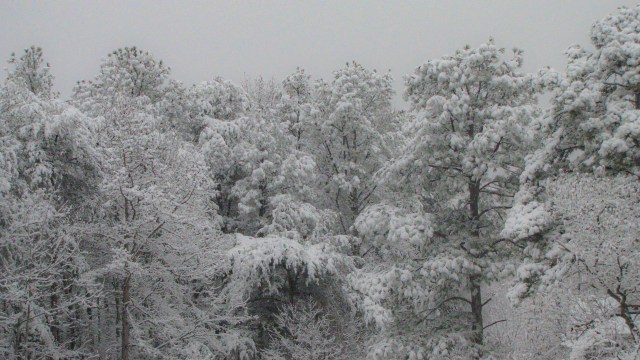
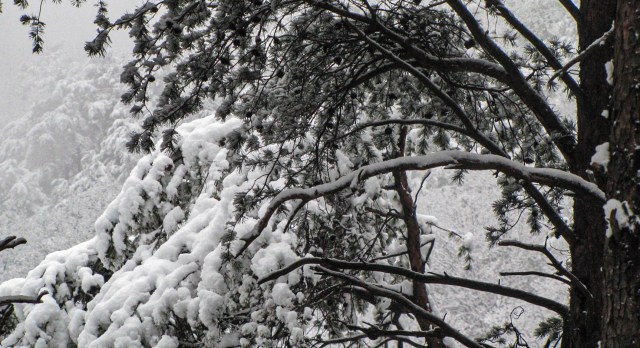
Then, on Christmas Eve, 2010, we got a rare White Christmas with maybe 4 or 5 inches of snow as seen in these two photos.
A more serious record, that of ice, came in the 1960s also. Ice, frozen solid on the ground, means bad news for the wildlife, as well as any hope of moving around. That year we had 12 inches – one foot – of ice on Green Mountain. We were stuck with no way out for a week. But we were okay. We had a wood burning fireplace, canned goods in the basement, and enough food.

With six kids in the house, we made good use of the ice and played in the woods a lot. One of my siblings even found a small, stranded screech owl. We took it home, fed it, and nursed it back to health over the next week and then released it when the ground thawed out. I still remember it, sitting in its cardboard box with a towel, looking at us as if wondering what we would do with it next. Sadly, nowadays I never hear screech owls up on the mountain anymore, and chuck-wills-widows are getting farther away and less frequent up there.
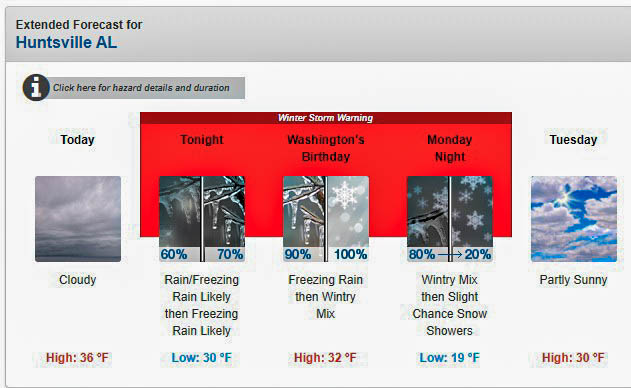
So we are currently predicting winter weather in a day or so. Just in time for a Monday holiday, President’s Day. Hopefully this will be a good opportunity to post some nice winter scenes here and on Facebook.
Posted in Photography, Weather | Tagged , , , , , | Leave a comment

Reciprocity in Music

Those of you who remember film in cameras will recall, perhaps, the notion of film reciprocity and the associated attribute of reciprocity failure; that quality whereby film, upon being exposed, started to lose its sensitivity to take in photons at the stated speed. The ASA of the film as it was called is just like its modern-day digital counterpart known as ISO.  ASA 64 was pretty slow, ASA 1600 was super fast and grainy. Usually, reciprocity wasn’t much of a problem, unless you did time exposures as in astrophotography; then, the on-going loss could be considerable. A good introduction to reciprocity and reciprocity failure can be found here.

So what has this to do with music? In an high-level way, I believe it has a lot to do not just with musical instruments, but with the progression of musical creativity in general. Let me explain the concept of reciprocity as it pertains to music.
Each generation is known for the music of that age. The 1920s with Jazz, the 1950s with rock, the 1960s with the British Invasion (among other genres), hard rock of the 1980s, the insipidness of the 2010s, and on and on. Each of these, I would state, was driven by the necessity to find new outlets for creativity due to the previous genre being ‘used up’.

For example, in our own domains of Bluegrass and Folk music, do you see many new songs being written with the basic elements of, say, a fiddle tune like Cripple Creek? Or an early Rock song with just your basic G, C, and D chords? Of course, there are the occasional exceptions, but as a trend, this seems to not be the case.

Stylistically further afield, The American composer and conductor Aaron Copeland refers to this same phenomenon in his book ‘What to Listen for in Music’ when he discusses contemporary music (this is in the context of Classical and Jazz music). From an historical music perspective, this seems to be a familiar peculiarity and, I would argue, the same reason for why ‘modern’ Classical music is unlike, say, Bourque music. Or why Elvis Presley is different from Elvin Bishop. Concerning why Contemporary music is unlike 19th century Romantic music, Copeland states:

“… the self-evident truth is that the romantic movement had reached it’s apogee by the end of the last century and nothing fresh was to be extracted from it.”¹

So then, this is what I think is going on here:

Each instrument and musical style in its present, static state can only produce so much innovation before diminishing returns overtake further efforts. At that point, creative efforts extend the useful life of the creative genre, but even that eventually narrows, forcing artists to look further afield for new sources of creativity. 

Thoughts?

Posted in Music in General, Philosophical Ramblings | Tagged , , , | Leave a comment

Winter – The Season of Textures

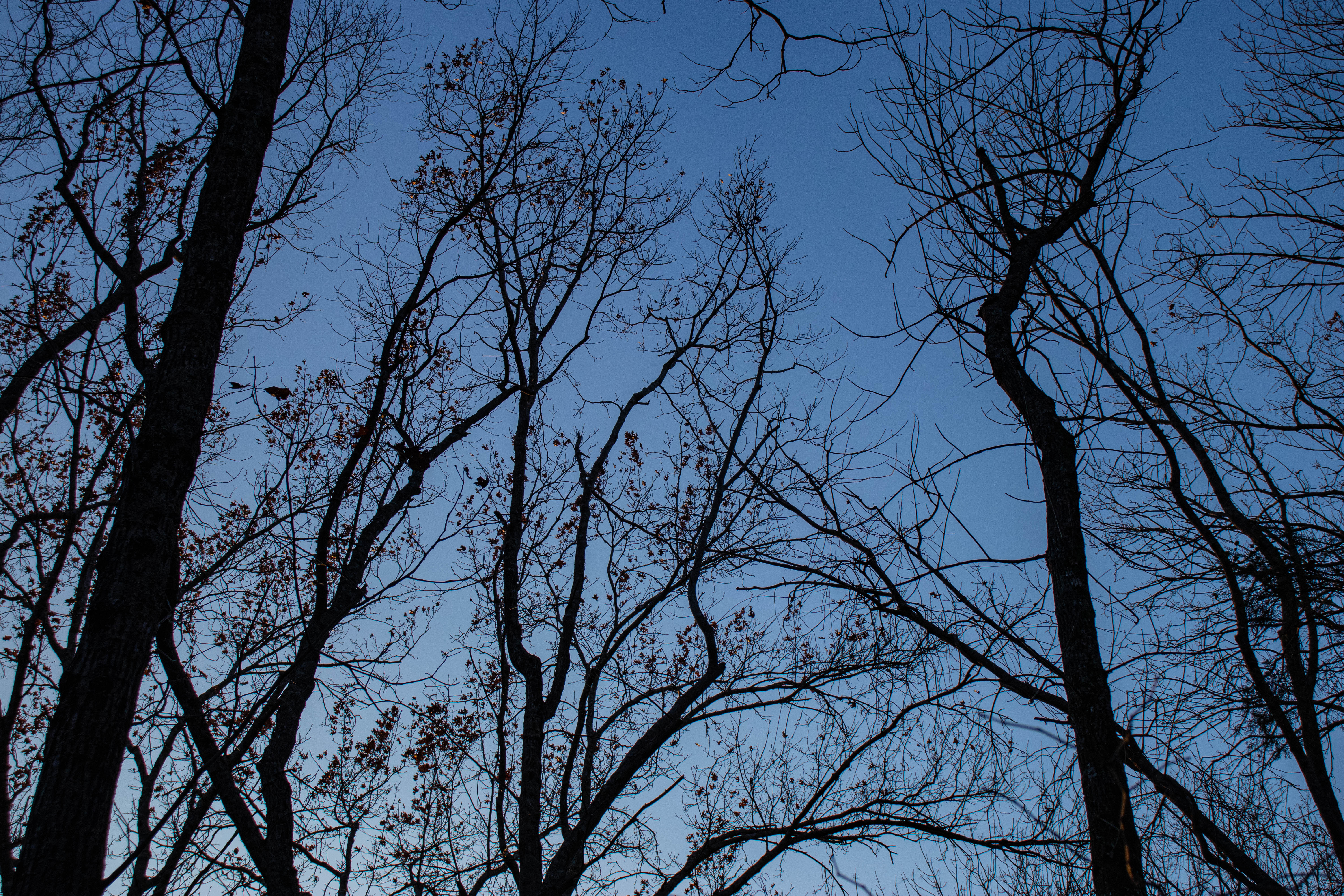
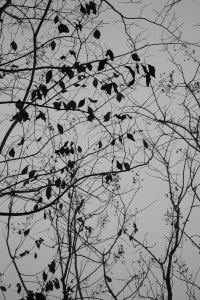
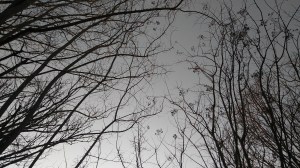
With winter comes barrenness. No bright spring or even fall colored leaves. Yet, winter has its own fascination that is devoid of bright color – you see it in the textures, shapes and patterns, hidden underneath the more obvious colors of other seasons. Once the leaves fall away, these patterns are what is left for display.

Some years ago, I hear or read the phrase “Winter – The Season of Textures”, and it has stuck with me, especially in obvious December, January, and February.

We talk about negative space in photograph composition. That’s where a lot or most of the space in a photo is taken up by a purposeful lack of detail. It doesn’t compete with the subject of the photo; instead, it helps to focus attention on the subject.

You can also find a similar, historical juxtaposition that strikes a similar chord to our topic of summer colors versus winter textures. Some classical writers were rather dismissive of color in art, seeing it as a distraction from the true glories of art, which were to them, embodied most in line and form.¹ Seldom if ever would anyone make similar arguments today, yet the distinction remains between the two.

I think winter textures are a similar compositional element to negative space. Because they lack other attractions, such as colors, they force you to seek what is of value within the frame. When you find that value in the textures and patterns, they become all the more striking.

Viewed this way, Winter is no longer a drab, dreary landscape, but an environment rich in undiscovered surprises.

You can find more examples in my photography portfolio in the Patterns & Textures album.

1 Kassia St. Clair, The Secret Lives of Color (New York: Penguin Books, 2017), p.29. Indeed, such notables as Herman Melville, Johann Wolfgang von Goethe, and Le Corbusier expressed various arguments against using color as expression in their respective fields.

Posted in Photography | Tagged , , , , | 2 Comments

5 Balances in Your Music

All of life is a series of balances. At least, that’s what I think. I often say that in response to discussions of complex topics, as though it is the be-all and end-all of the subject. In reality, I do know that simply saying that ignores much of whatever is specific to that issue. In general, though, it is a good maxim to follow. Here’s a few specific issues that we banjo players need to keep in balance.
1 – Being accurate and clean vs pushing yourself to play faster
When we are first learning to play, speed is that illusive quality that we strive for, yet it can slip away if we try for it to the exclusion of playing cleanly and accurately.

2 – Playing ‘straight’ vs playing bluesy
Playing bluesy licks can be addictive. They really sound cool and most of them are physically fun to play as well once you master them. But just like ice cream in your diet, it shouldn’t be a large part of your repertoire (unless you are playing jazz, of course).

3 – Watching the right hand vs watching the left hand
Unless you teach beginning banjo lessons or else are around beginners, you may have forgotten this one. But it is a real problem for players just starting out. I’ve even had some students remark that they can get dizzy trying to go back and forth watching both hands.

4 – Comfort vs functionality
This would be something like rigid hand posture, where you can adopt either a relaxed form or the classical chord form commonly seen in classical guitar performance, for instance. I would guess that about 10% of my students naturally have adopted a more classical fretting hand position. More power to them, as they now have the advantages of a classical, hand-away-from-the neck position yet without having to go through the adjustments from a more comfortable close-to-the-neck position.

5 – Fingers down: restriction vs control
Banjo players are all over the map on this one. Some gain control of both ring and little fingers, placing them firmly on the drum head right from the start. At the other extreme, I had one student long ago who deliberately did not put any fingers down when playing Scruggs style. I’ve long forgotten his explanation of why he did that, but he was firmly opposed to any fingers down.

Bottom line: you know how far you can push yourself before you start getting sloppy.

Posted in Tips & Techniques | Tagged , , , , | Leave a comment

Trail Building: How I Got Started

I’ve mentioned here and there that I am a volunteer Trail Care Partner with the Land Trust of North Alabama. I’ll call them just ‘the Land Trust’ here for simplicity. Been a volunteer with them since April of 2016. That’s when I received a campaign email from the Land Trust. It must have been sent out to a large distribution list, because I wasn’t on any sort of Land Trust email list. I had heard of the Land Trust and I knew that they owned a lot of land that some folks hiked on, but that was about the extent of my knowledge of the Land Trust at that time.
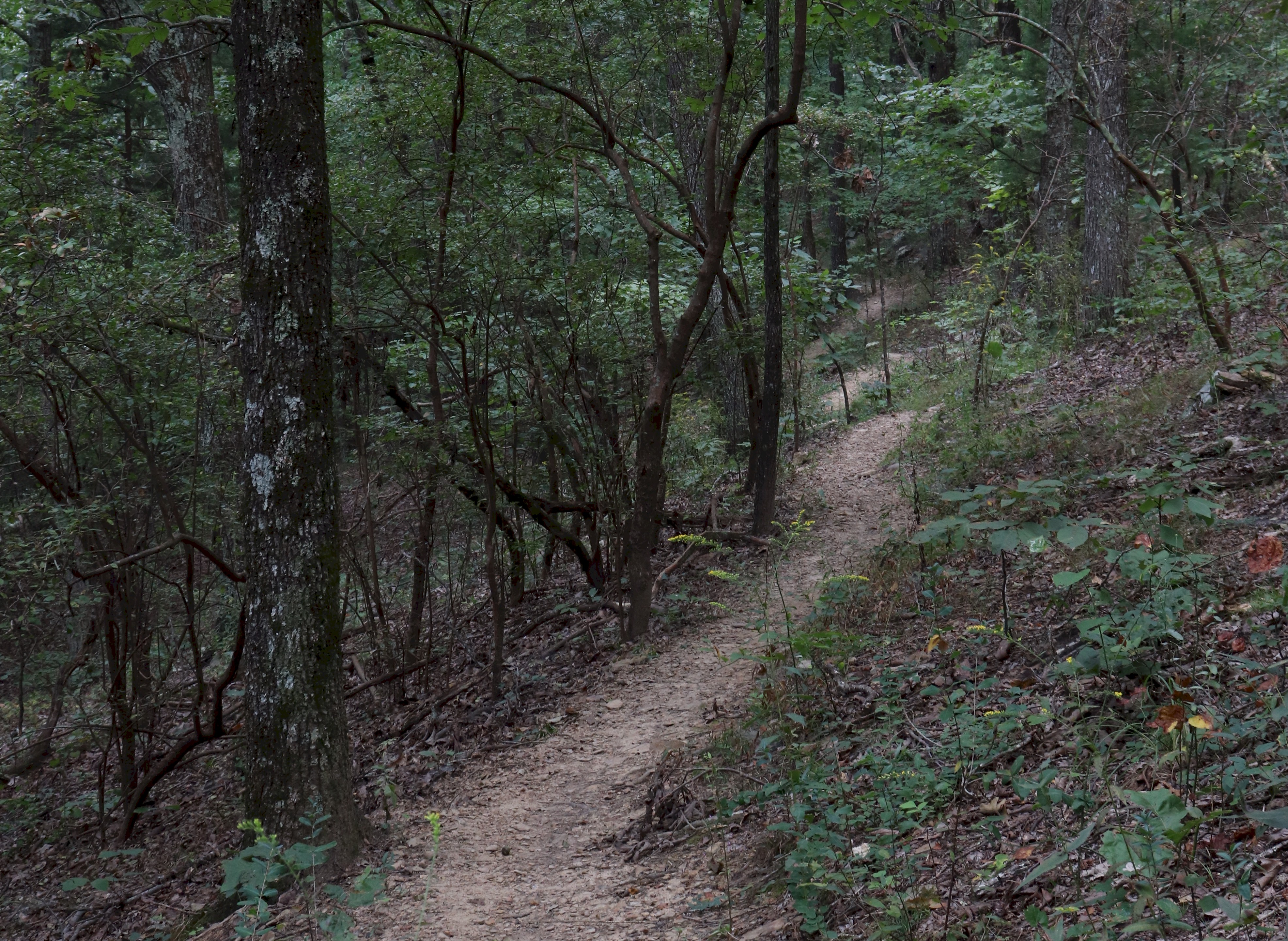
So what made me stop in my tracks and read this particular email? It was talking about some place near and dear to me; the woods behind my folk’s house on Green Mountain where I grew up. This was the same land that my brothers and I would spend entire summers traipsing around in, having adventures, discovering the big deal with poison ivy and snakes, and just generally experiencing all the life of growing up ‘in the woods’. You know, somehow, amidst all the climbing, cave exploring, and hiking, I managed to never get lost (that I can remember, anyway) nor to break a bone…

But I digress – you see how this email brought back fond memories!

So this email was talking about how a significant portion of Alum Cave Hollow (now called just Alum Hollow) had recently been donated to the Land Trust. And, they were about to start putting in trails in this new nature preserve. At this, I knew I had to be a part of whatever that shaped up to be.

The timing of this Land Trust announcement was significant too, because about 3 or 4 years prior to this, a friend and I had visited Alum Cave Ledge. We were standing there, silent, looking out over the hollow below. I whispered about how you can, occasionally, hear bands of wild turkeys in the hollow, unseen, but nearby. Then He and I hatched up a dream. Wouldn’t it be grand if we owned this hollow, and turned it into a preserve? With trails and bridges and all the other things that you could do here? We both agreed, yes that would indeed be grand… and totally just a dream too!

Oh wow! So just tell me which way do I go to sign up? Obviously, I did sign up, and I did start volunteering with the Land Trust.

As it turned out, the first big event scheduled at the new Green Mountain Preserve, fell on National Trails Day that year. My first work day with the Land Trust saw maybe 40 or 50 people there for the inaugural Green Mountain Nature Preserve activity. With so many in attendance, we managed to complete East Plateau Trail and to build the Lockheed bridge as well.

A bit of history. Alum Hollow Trail was pretty much already in place by this time. The western portion, over Alum Cave Ledge, had just recently been completed, but the eastern parts of it had existed as far back as when I was ten years old (that’s 1967) and my oldest brother had put a path over to the nearest creek, about a quarter mile from our house (hence, the name I call it; Quarter-mile Creek). In the 1990s, I was an avid runner and from time to time I would injure my knee. In order to ramp up to running on asphalt again, I needed a soft path. I put in a loop trail that was exactly 1 kilometer long, tying it into what is now Alum Hollow Trail where it runs along the bluff just east of Cruse Point. Our neighbors Kevin and Katey had also previously contributed eastern parts of the current trail to complete what we have today.

The rest of the story (and there’s a lot of it) – well, that’s something I’ll add to here as time goes on!

Posted in Trails | Tagged , , | Leave a comment

When the Teacher is Taught by the Student

Teaching, by its very nature, implies a certain terminus. Courses are scheduled for a finite period of time and are completed. One reason being that no teacher could possibly teach someone forever. Teachers have finite information which they share; when that information has been successfully conveyed, the course of instruction has reached its goal, and that particular phase of learning has ended.

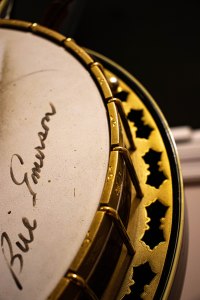
Bill Emerson Signature

So it is with banjo teaching. Even as new students sign up and I begin the process once again, it has that characteristic enthusiasm of a project just started. I love that feeling, and yet I realize that for each student one day this too will be gone. But I have learned to thoroughly enjoy it for what it is, right now. I know the day is coming when, for whatever reason, something will break the continuity of lessons. Although life-long friendships are frequently made, learning and teaching in a formal sense ceases for that student and me. It’s just the nature of the process.

No student has gone past that above-described limit of what I can teach them; except for one. I’ll call him Al. Al was my very first student when I started teaching formally, and he continued until physical factors beyond his control forced him to stop.

You might think after all those years, that he was a very advanced student; he wasn’t. Well, not in the traditional sense of being able to execute difficult techniques and improvise and knowing tons of songs and all that. No, he wasn’t at that level, but… he did have something else that, to me, was far more important. Something that spoke of being able to handle whatever life throws at you. He understood the nature of the journey. He had the big picture, more clearly that I had ever seen it before in a banjo student. My proof? How else could he have lasted longer with lessons that anyone else (by far, I might add) if he did not clearly understand that the big picture is to enjoy the process, not to simply strive to make it to some self-defined point of proficiency?

A self-defined point of proficiency? Isn’t that just a way to gauge your progress towards some goal? And if you already know your goal, and you are confident of your progress towards it, do you really need to somehow measure that progress?

So using that as a definition, I’m very glad to say that Al knocked one out of the ballpark when it came to taking banjo lessons. He knew the real process going on was one of simply enjoying the process and discovering your abilities. And I was made far more aware and appreciative of that not-so-small fact in witnessing it firsthand.

Thanks, Al for all the lessons. We both learned a lot, but we also had a great time in the process!

Posted in Banjoists and Others, Beginning Banjo, Philosophical Ramblings | Tagged , , , , , | Leave a comment

Patterns in Nature

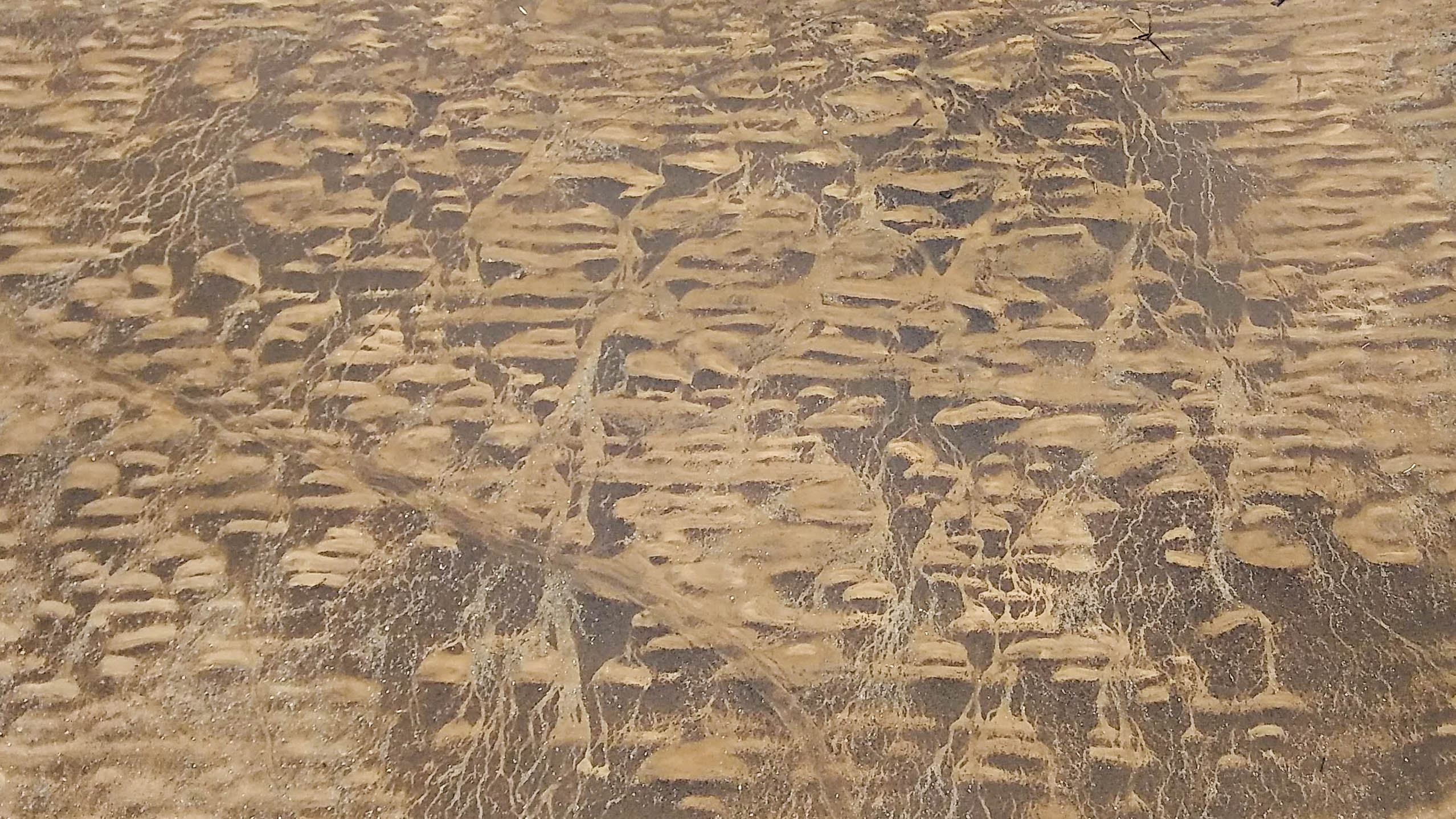
Here are some photos I’ve taken over the years of something that is rather fascinating to me: patterns found in nature. Wikipedia has a great resource on these
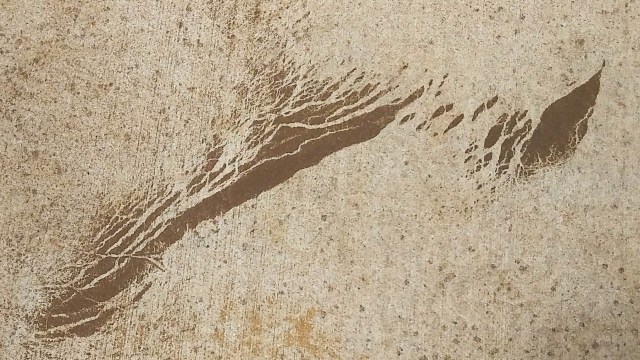
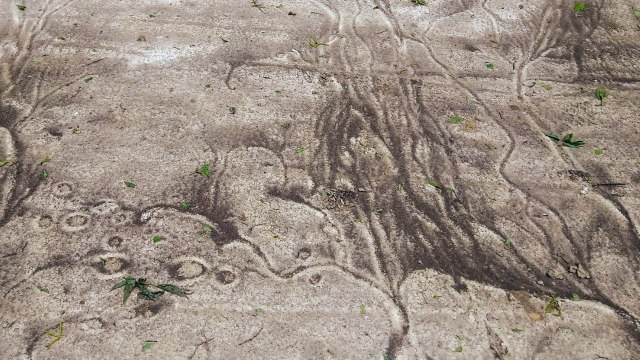
Although patterns are found almost everywhere you look, these particular patterns are caused in a specific way and in a few places, so they are rather uncommon, maybe you could even call them rare. Looking at the photos, of which I have included just a few here, you see there is not much context, intentionally. That way, you are forced to focus on the appearance of the patterns.

Nevertheless, here are the details. If you look closely, you might get a few clues that this is on a sidewalk, and you would be close. This particular set of pattern photos were all taken on the northern section of Aldridge Creek Greenway in south Huntsville. Basically, they are the result of rain water flowing and drying over the rough concrete, yet so many factors come into play here. To mention several, it depends on:

  • Overall volume of rainfall
  • Rate of rainfall
  • The content of the rainwater flowing over the concrete (more sediment is better)
  • Time since rainfall
  • Surface texture of the concrete pathway
  • Slope of the pathway (very slight)
  • Debris already on the pathway before the rain
  • Openness of the pathway, or at least few trees nearby
  • Stronger wind during and after the rain may have an interesting effect

As you can imagine, I was quite fortunate to come upon these patterns at first. I soon learned to recognize the conditions and so I can now maximize my chances of finding such patterns again. What I look for is the following.
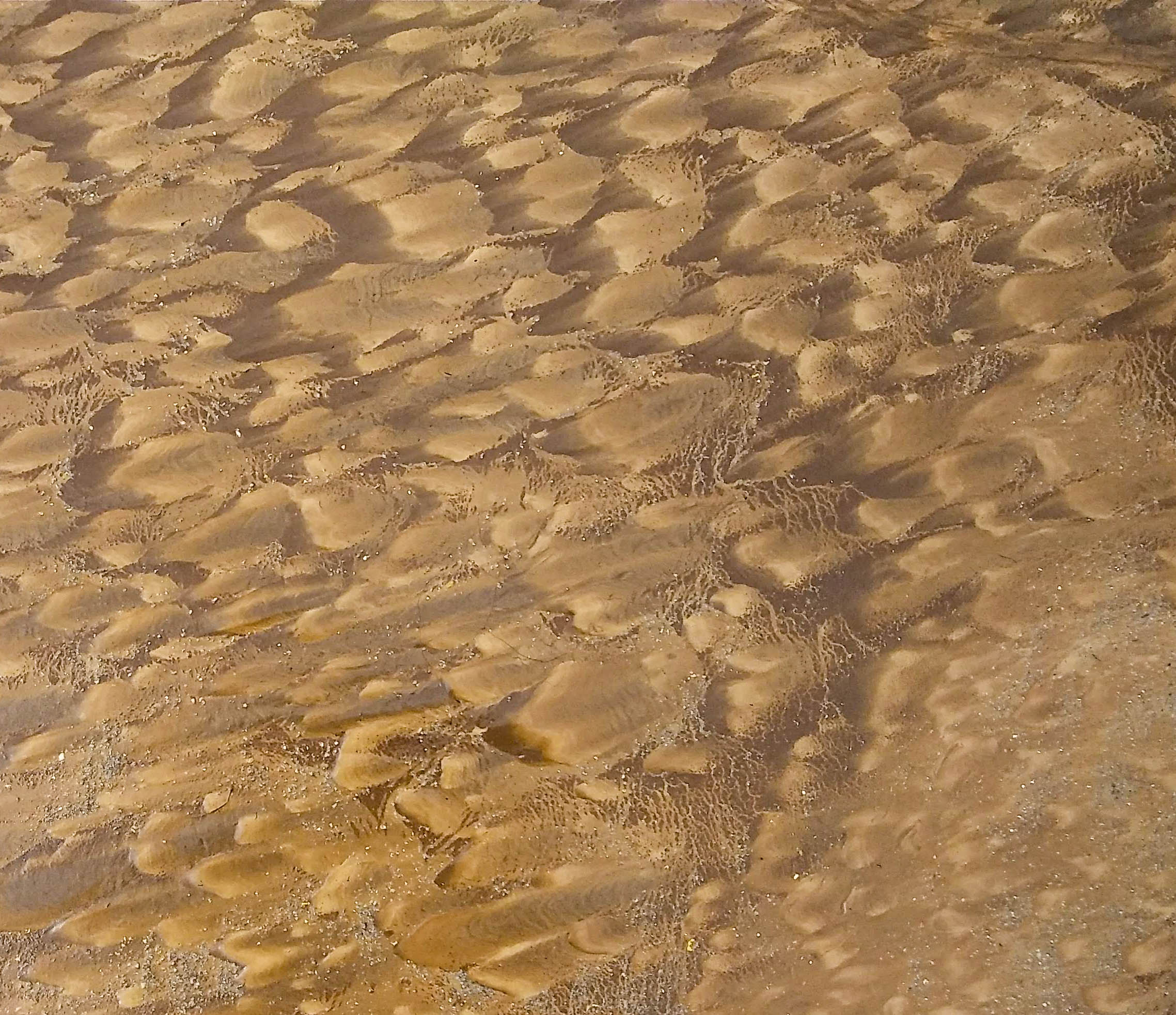
  • A rainfall of maybe 1 or 2 inches the previous evening or during the night, which is over by morning.
  • A broad pathway, such as the 10-foot wide greenways in Huntsville.
  • A slight slope to the pathway, which I’ve not yet understood the cause-and-effect, but I see it needs to be slightly sloped.
  • Roughness of the concrete. Asphalt doesn’t seem to give results due to its smoothness, I think. Fortunately, all greenway concrete seems to have that required amount of roughness.

My favorite place to look for these is on the Aldridge Creek Greenway from Green Mountain Road to the current terminus of the greenway about a mile north.

If you’re interested, I have a larger set of photos on my photography portfolio in the album titled “Patterns & Textures”.

Posted in Photography, Trails | Tagged , , , , , | Leave a comment

Rethinking My Online Content

It’s time I revisited my various online sites; this blog, my website (especially my outdated website!) and my photography portfolio hosted on Wix.
With three different online sites, it is starting to get confusing. I need a more cohesive collection of everything. It should look like it was all designed together, which means all three have to be deliberately thought through together. I’m considering these hosting options below.

You may recognize the last three as being website builders, rather than simply website hosts. I have a photography portfolio on Wix (the free plan) and it was so simple to put together. Of course, there is almost always that trade-off with technology: the simpler it is, the less versatile it is; and vice-versa. There are exceptions to that, but as a general rule, it holds.

  1. WordPress. Roughly 1/4 of all websites on the web are on WordPress, so I have read. That is amazing and speaks to how good WordPress is, although it isn’t for the technically challenged.
  2. Wix. Wix is really easy, like all website builders. I hear that Wix isn’t all that great for a blog though.
  3. SquareSpace. Costs about the same as Wix, and has a reputation for being the classiest-looking builder. Also more versatile and not as intuitive due to that versatility.
  4. Weebly. The cheapest of these three builders. Also very good for website beginners, so maybe not as versatile.

Good Reasons to Consider Changing
The website just looks dated – because it is dated. Being a web developer, I designed it myself back around 2007, before all the social media options that we have today. Browsers, web standards, styles, and UI/UX (user interface/user experience) trends have all changed since then.

What’s Currently Good
Website SEO – It’s not like I have a lot of online competition for banjo students in North Alabama, but doing my own SEO does get me to the top of searches. My website is probably the most common way that prospective students find me, next being word of mouth. Interestingly, even though I get a good bit of results from my outdated website, I don’t seem to get much in terms of student referrals from my WordPress blog, which is more active. Nevertheless, I think I’ll keep the blog on WordPress. WordPress gets such high ratings, especially when it comes to blogging.

I believe I’ll transfer my domain http://www.PhillGibson.com over to whichever one of the three website builders I decide on, and keep the sub-domain blog.PhillGibson.com on WordPress. Maybe dress it up and bit more, but leave it here. I think I’ll also keep the photography portfolio on Wix; I’ve changed the layout to handle more photos recently.

So What’s Ahead? 
Still more banjo blogs. Maybe more on topics further afield also, like photography and trail-building activities with the Land Trust of North Alabama.

But what do I think I’m ‘qualified’ to blog about? Thing is, you have to ask yourself what is it you can say with some degree of authority and pretty much stick to that. Otherwise, you are really just stating an opinion, and I feel uncomfortable leaving it at that. I pondered this a bit and came to the conclusion that I’m not an authority on a lot of stuff that I’m interested in. But that’s not the same as being a newbie at something and blogging about it – you can effectively blog on topics you are learning. Just make sure that the context you are writing from is a newcomers experience. Lessons learned is a very good example.

So maybe I should say expect more topics like learning drone photography, or learning 3-D modeling, along with the more substantial topics. 

At any rate, do look for an updated website soon, plus more varied content here.

Posted in Internet & Social Media | Leave a comment

Remember Your Early Goals

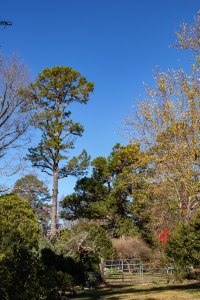
I remember when I first started playing the banjo, one of my main goals was to sit under a pine tree (a very specific one) and play Foggy Mountain Breakdown. Somehow, that goal got lost rather quickly for me, and I forgot about it for a few years. Until one day, it came back to me. Quickly, I went over to the tree about 100 yards from my folk’s house. Sitting there overlooking a quiet meadow, I performed the expected song. The deed was done and I remember that otherwise mundane event to this day.

Pine Tree by The Gate

So I went on to set other goals; usually more complex, yet generally not as significant. Looking back, at times it was a little like attaining goals simply for the collection of goals. As time went on and I was able to do more and more, new things started to lose that thrill of the first things I had accomplished.

But you have to remember what brought you here. Why? Because there is this mental phenomenon that goes on as you become more advanced with anything. You want to avoid it. I don’t have a name for it, but if you have ever excelled at anything, you will surely recognize it. You become jaded to the very thing that once fascinated you, even as you become better and better at it. You find yourself longing for “the good old days” when you first started; when the whole world revolved around this new activity or concept, and all other things even became more fascinating and successful because of it.

I remember seeing the movie ‘Coal Miner’s Daughter’, the story of Loretta Lynn. In the movie, she becomes more and more successful until one day, she is frustrated with the direction everything is going and tells her husband Doolittle that she wants to build a cabin. Just a simple little cabin to start over in. I suspect she was thinking along the same lines as what we are talking about here.

So, if that sounds familiar, know that I have also been there; still go there from time to time, even. Having been there, I do think I know what it is you must do to keep that fascination intact.

1) Set goals. Either write them down, or keep them important enough to you that you’ll be able to look back and tell where you came from and where you are.

2) Remember the details. Remember them in two ways.

  • If you’ve been playing a while, revisit your early days of learning to play in as much details as possible. These are the reasons you started playing in the first place. Make the mental connection between your early goals (ever if they we just general goals such as ‘learning to play the banjo’) and your current motivation.
  • Also remember todays’ details. Because you have goals to work towards, remember as much detail as you can, and let this become the material that helps make even today a continuation of “the good old days”.

3) Learn something new! Of course, we should all be learning something new, but often, we get away from it. This has such a positive effect, you’ll definitely want to keep this in mind.

I hope this helps when you are feeling unmotivated to play!

Posted in Philosophical Ramblings | Tagged , , | Leave a comment

Strength, Accuracy, and Speed

If you’re the type of musician who just likes to grab your instrument and start playing without much analysis of techniques, you probably won’t get much from this post. It’s a very in-depth look at what you are really asking of your hands when you ask them to play music.

It’s also from the perspective of someone who had the ‘opportunity’ of lying on my back for some time while I recovered the use of the left side of my body. As you can imagine, I did a lot of thinking, planning, analyzing, and ruminating on how we actually do things with our hands and how our muscles can possibly relate to the messages coming from our brain.

That’s when I started to realize this general fact:

All physical skills can be condensed into three qualities:
strength, accuracy, and speed.

Banjo Practice

Banjo Practice, by Phill Gibson

When a stroke occurs in the brain, in a way, it loses the directions on how to find, say, your hands and fingers. It also forgets how far away they are and how long it takes to send and receive a message, not unlike when you ping an IP address. Lastly, it also forgets how much ‘signal’ to send in order to affect a certain amount of response, or strength.

Here’s an example. Say you want to play a chord on a stringed instrument. After lifting and slightly rotating your arm, you tell your hand and fingers to start moving into a predefined set of positions. Each finger position is different for each chord. Whether you’re playing a simple chord with no vamping sliding or other added techniques, or you’re playing something with those fretting-hand techniques, you are asking your hands and fingers to:

  1. Apply enough pressure onto the string to cleanly press the string onto the fret, yet not enough to make it painful to your finger tip. This is strength.
  2. Apply this place of contact with the string/fretboard combination with an accuracy of better than about 1 millimeter, with absolutely no room for corrections after the placement has been made. This is accuracy.
  3. Apply this combination of strength and accuracy in a variable amount of time, which often includes doing it in a fraction of a second, depending on the technique and tempo of the song. This is speed. Oh, and that’s just one finger! You need to multiply that complexity by a factor of 2 to 4, because…
  4. Do all of this simultaneously with as many fingers as is required, usually two to four fingers on the fretting hand for a simple chord.

So from that perspective, doing anything on the fretboard seems a daunting task! But looking at everything in terms of those three qualities also helps you isolate and refine whatever the issue is.

Here’s another example. When I was trying to get back the ability to form decent chords after my stroke, I found that I could make much better progress if I examined what I was (or wasn’t) doing and categorize it as one of these three qualities.

  1. If it was strength, that meant that I was either not pressing hard enough (usually the case) or maybe pressing too hard and my finger tip was screaming for me to stop because it was painful. My solution was to go over, and over, and over that one application of pressure. I would also have to make sure the muscles in play also have had enough exercise so that they were capable of doing simple tasks normally. The gym had one of these unusual hand exercisers in a basket of miscellaneous gadgets and I found it very worthwhile to exercise my hand and fingers. Here it is at Amazon: https://www.amazon.com/dp/B008N3KZEC/?coliid=ILB0A7Y9TTZQ1&colid=32BO599ZRYRID&psc=0&ref_=lv_ov_lig_dp_it.
  2. For accuracy, it was really easy to tell; just listen to the chord. Usually, ill-formed chords were the result of poor accuracy. You can also guess the solution: extreme repetition, emphasizing exact, instant positioning of each individual finger, then all fingers together. 
  3. For speed, well, here I’m not talking as much about breakdown-speed banjo breaks as much as just the speed it takes to move your fingers in simple fashion for basic tasks (such as forming chords) in a reasonable amount of time (basic speed, I’ll call it). Fast speed will come along just as it did the first time: gradually, and with much diligence and practice. For basic speed, I practiced my strength and accuracy with an eye towards simply making it a habit once again so that I had the smallest of movements in my muscle memory. At that point and with a relaxed touch, basic speed did indeed start to improve.

So that is a very in-depth look at the details of how I made progress with regaining my banjo playing ability after my stroke. It was a long process, it was not very pleasant, and I still have some way to go to get back to where I was, but by delving into analysis of such minute points of execution, it did the trick! 

Posted in Beginning Banjo, Philosophical Ramblings, Teaching, Tips & Techniques | Tagged , , , | Leave a comment