Playing Banjo 4-Finger Style – Applying it to a Song

Intro | Background | Observations | Benefits & Challenges | Getting Started | More Getting Started | Applying it to a Song

Finally, here’s a concrete example of how I’m approaching the whole four-finger banjo process.

This is a four-finger version of ‘Buffalo Gals’ using a few four-finger licks. It done in TablEdit. To actually hear about what it sounds like in real life, I like to increase the speed in TablEdit to about 160 – 200%. To do this in TablEdit, go to the MIDI menu and click ‘Relative Speed’ and move the horizontal slider in the upper left from 100% to a higher speed.

Act now, and you’ll also receive a recently-created single string break I’ve done for Buffalo Gals! Also done in TablEdit.

Don’t forget to remember to have fun with this new style, and if you decide to pursue it, do let me know how it’s going!

Posted in 4-Finger Style, Reno & Single-String Style | Tagged , , | 1 Comment

Playing Banjo 4-Finger Style – Getting Started Yet More

Intro | Background | Observations | Benefits & Challenges | Getting Started | More Getting Started | Applying it to a Song

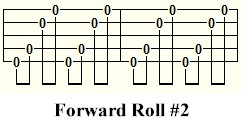
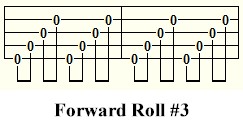
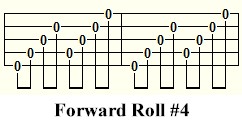
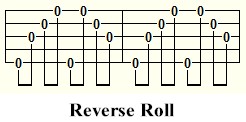
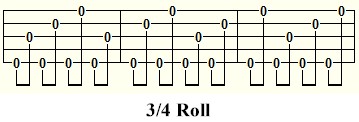
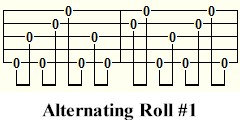
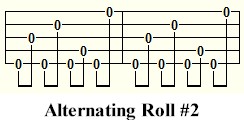
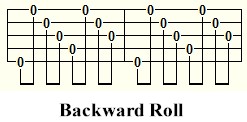
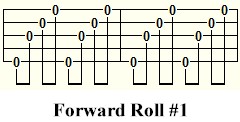
Now let’s try some exercises such as the following, which are simply four-finger equivalents of some well-known three-finger rolls; the forward roll, backward roll, reverse roll and a couple of variations of the alternating thumb roll. (Note: This terminology is referenced from the names of rolls as found in Earl Scruggs’s book). Practice these as being phase I of your studies in 4-finger playing. Just as when you were learning your three-finger rolls as a beginner, practice these literally at least 500 times. 1000 for each roll would be even better!

Four finger style banjo - Forward Roll #1

Four finger style banjo - forward roll #2

Four finger style banjo - forward roll #3

Four finger style banjo - forward roll #4

Four finger style banjo  - reverse roll

Four finger style banjo - three-fourths roll

Four finger style banjo - alternating thumb roll #1

Four finger style banjo - alternating thumb roll #2

Four finger style banjo - backward roll

One thing you’ll quickly notice in doing these exercises is that the ring finger simply cannot be lifted as high above the banjo bridge as other fingers! Perhaps some folks can do this, but I don’t think many people will find it an easy task to get much lift above the bridge with the ring finger. You’ll also soon see why this is important; the ring finger, now a picking finger, comes quite close to the first string, more so than any other finger. You wouldn’t want this finger to get lazy and occasionally hit the first string, especially if you’re not using the ring finger for a bit and it’s just sort of hanging there waiting for another four-finger roll to come along. One solution to this is to use a higher overall hand position. That’s a bit tougher for me, as my right hand position is pretty low to start with.

Because of this inability of the ring finger to get very high, the backward roll (the last one presented on this page) is an especially difficult one to do.

The next phase, which you can do concurrently with the rolls if you like, is to find good fretting positions to match these new roll patterns. At first, this simply means to do the rolls with various chords you already know. Later, though, this means to re-engineer some of you left-hand techniques; slides, hammer-ons and pull-offs, for instance. Start with left-hand techniques that go well with alternating thumb patterns, since they are already based on 4 notes, as opposed to three notes as with forward and backward rolls.

Create a new lick or two using this process and try this on one of your slower songs. Keep on working at it and see how it starts to sound once you start getting a moderate amount of speed to it (maybe 5 or 6 notes per second). Do you like the sound of it? If so, I suspect it’s worth pursuing!

Of course, you realize this is going to take some time. Remember how much effort you had to put into learning three-finger style? Well, this is no different – you’ll need to go find your initial enthusiasm once again to do your best at this, just as you did with three-finger. Be persistent. And don’t overkill with it. Remember to keep three-finger Scruggs as the ‘glue’ to bind everything else together and I believe it will be most effective.

Posted in 4-Finger Style | Tagged | 8 Comments

Playing Banjo 4-Finger Style – Getting Started

Intro | Background | Observations | Benefits & Challenges | Getting Started | More Getting Started | Applying it to a Song

For starting starters (apologies to Dr. Seuss), it is best to make use of a little-known fact about how our brains process such things as banjo rolls. Did you know it doesn’t matter to your brain if you switch some of your fingers around when playing banjo rolls? It’s true. Not just any fingers can be switched however. Try this: play any song you already know on the banjo – even one of your more challenging tunes. Instead of using you thumb, index and middle fingers of the right hand to pick, use your thumb, middle and ring fingers. Go ahead and try it now, but slow it way down. Do you see how you didn’t have to think about it any more than you would if using your ‘regular’ picking fingers? You’ll also notice how you had to slow it way down, due to the fact that the ring finger is way behind the learning curve, even if it already knows what string to pick. I must say, that is a weird feeling for someone who already knows how to play the banjo!

So one of the first tasks then, is to get that ring finger more up-to-speed. Always remember to keep a pick on the ring finger when you are practicing this style. As with any new style you learn, set aside some time for this one technique for a while. Try to get to where you can feel a level of confidence in what you are doing before increasing speed. Beginning speed can be a fairly relative thing; what I’m doing as I progress with this style is to start at about 4 to 6 notes per second (roughly 60 to 70 BPM on a metronome). Later exercises and rolls may need to slow down a bit, but for now, this can actually go a little faster due to the fact that your brain already knows what song to pick.

Practice this for several weeks. It’s going to take a little while to get used to it and to get the ring finger feeling more adept at a new role (pun intended) in life.

Posted in 4-Finger Style | Tagged | 1 Comment

Playing Banjo 4-Finger Style – Benefits & Challenges

Intro | Background | Observations | Benefits & Challenges | Getting Started | More Getting Started | Applying it to a Song

Benefits
A new sound. Skillfully playing a four-finger roll can give you a completely new cadence to add to your picking repertoire, just as three-finger playing did in comparison to two-finger playing.

Speed. Not speed just for the sake of speed, but as an extra spice, if you will. Being able to play a really fast breakdown and being able to modify the cadence of your picking is something that will be readily apparent in your playing.

Versatility. With an increased repertoire of rolls at your disposal, you’ll be able to vary your breaks to a much larger extent. Think about going from 2-finger (such as in single-string style) to 3-finger Scruggs style. Now imagine adding another finger and you’ll open up even more avenues to explore with new rolls. Add that to your existing 2 and 3 finger techniques and you’ll have even more!

Challenges
One big challenge I immediately saw upon donning a pick on my right ring finger was that everything I had always taught myself about keeping that ring finger down had to go. “Heresy!” I said. What if I want to play standard stuff with three fingers and just pop a quick 4-finger roll in there occasionally? I could, but I would have to keep that pick on for the whole song, which means I’d better get used to wearing it for any of a variety of picking situations: pull-offs, double pull-offs, Reno-style thumb brushes, up-the neck stuff, etc. Would that be worth it?

Another challenge is simply the newness of it. It really is starting over again, complete with the excruciating slowness of beginning anything for the first time. But I remind myself of the fastest banjo player I had ever seen (at the time). I never knew his name, or the band he was in. He was a banjo player on APT (Alabama Public Television) back in the late 70’s. He could play about 15 notes per second. But what was really inspiring about him was the fact that he had no thumb! Perhaps he had been in an accident, I don’t know – but he had learned to use his index finger to pick down and his middle and ring fingers to pick up. Simply amazing! If he could learn that, then I could learn anything, I have since told myself.

Also, does this mean you won’t be able to play three-finger style anymore, as your fingers will somehow not be able to do both? I don’t think so. I can play both Scruggs style and single string style without each interfering with the other, for instance. And so far, experience has validated this. As I improve with this new technique, I find that I can do it either with or without that 4th pick, keeping the ring finger down on the head when the time comes to do that.

One more challenge I’ll list here is that with four fingers, the number of possible rolls increases tremendously. I’m not sure how many of these are truly practical rolls, but I’m sure there are more variations than you have for 3 fingers.

Posted in 4-Finger Style | Tagged | 4 Comments

Playing Banjo 4-Finger Style – Some Observations

Intro | Background | Observations | Benefits & Challenges | Getting Started | More Getting Started | Applying it to a Song

Now move forward in time to today. A few banjo players, seeking new boundaries to push, have started to use not only two fingers (one way to do single string style) and three fingers (Scruggs, melodic and single string styles), but 4 fingers as well. Not surprisingly, some of the changes brought about by going from 2 to 3 finger style also apply in going from 3 to 4 finger style. Notably:

1) Speed increases by roughly 33% over 3 finger styles. Again, this assumes the same amount of effort is expended for either style.

2) The cadence changes once again, although I think a bit more subtly. Here, I’m thinking of 4-finger style not as a replacement for 3-finger styles, but as a supplement; much the way single string and melodic style licks can be interspersed in a Scruggs-style tune. To me, Scruggs style is the ‘glue’ that binds everything together. So it is more subtle a change in cadence. Also, we aren’t converting everything from 3-finger to 4-finger style – just what’s needed.

I suppose someone could convert the whole song into a 4-finger style, but I don’t see enough ‘return on investment’ to warrant that, normally. We can already do just fine with incredibly rich musical expression within Scruggs style for the majority of technical requirements. Why reinvent the wheel when the end result will be pretty much the same? In other words, use 4-finger style for licks that will indeed showcase it, not for things better done with 3 fingers. Yes, speed could be a valid reason, what with approximately a 33% increase using 4 fingers. Just remember though, as you learn to pick with 4 fingers, it is going to take a little while to actually see that speed come to fruition, especially with more detailed rolls and licks.

Notice in the two-point list above, I didn’t include point #3 from the last blog (tunes could be reworked to take advantage of the new 3-finger style). That’s because I don’t see 4-finger style as being as revolutionary as three-finger was: with 4-finger style, you can fit more notes (so that it sounds faster) into some licks with a subtle new cadence that gets noticed. And, it also fits well into your existing songs – no need to rework everything from scratch.

Next blog, I’ll start detailing the benefits and challenges of 4-finger style. After that, I’ll look at how to get started, plus some of my own thoughts, perceptions and choices in learning 4-finger style banjo playing.

Posted in 4-Finger Style | Tagged | 2 Comments

Playing Banjo 4-Finger Style – Background

Intro | Background | Observations | Benefits & Challenges | Getting Started | More Getting Started | Applying it to a Song

Last blog, I gave a brief introduction to the topic of playing bluegrass banjo with four (right hand) fingers, rather than the usual three. Now, we’ll go over a bit of historical perspective.

Some Background & Other Observations
1946is a year bluegrass banjo pickers will always remember. That’s when Earl Scruggs, at the Grand ‘Ol Opry, introduced the world to 3-finger style banjo playing, when a lot of folks were still playing banjo with either two fingers or clawhammer style. As many banjo players know nowadays, 1946 was ripe for just this quantum leap in banjo technique. Several other players, among them Don Reno and Snuffy Jenkins, were also starting to play 3-finger style, especially around the North Carolina area that Earl Scruggs came from.

3-finger style banjo was revolutionary for several reasons.
1. Physically, it allowed the use of one more finer in rolls, thus making it roughly 50% faster-sounding for the same amount of effort with two fingers.
2. It created a totally new cadence to rolls. Combined with the existing syncopated sound of the 5th drone string, no wonder it was such a fascinating new sound.
3. Given the speed that was now possible with 3 finger style playing, songs could be played with a more exciting drive. Old songs could be reworked and new songs written just for a fast bluegrass feel.

Since that day, we have added several new and exciting techniques and styles, including Reno style, which embodies single string playing, melodic style which emulates note-for-note fiddle tunes and many new techniques that extend these styles into not only bluegrass, but also jazz, country, rock and other genres.

Posted in 4-Finger Style | Tagged | 2 Comments

Playing Banjo 4-Finger Style – Introduction

Intro | Background | Observations | Benefits & Challenges | Getting Started | More Getting Started | Applying it to a Song

Have you heard of this yet? Picking a 5-string banjo with 4 fingers instead of the usual 3, as in Scruggs style. Greg Liszt is one banjoist who is experimenting with this new style and it sounds very interesting to me. After all, Earl Scruggs popularized three-finger style playing at a time when two-finger and clawhammer styles were the norm. I’ve been playing banjo for 30+ years, mainly Scruggs and melodic, along with some single string, clawhammer and two-finger styles, but I’m just learning four-finger style. Hopefully, I’ll have some good lessons learned to post here as time goes by.

So I’m starting a series of blogs here on playing a 5-string banjo in 4-finger style. What I’ll do first is examine the historical background, then blog on the practical challenges and benefits of playing a 4-finger style of banjo and finish up with looking at how to get started and some of my own experiences in learning a new style, coming from a Scruggs, melodic and single-string perspective.

Next blog, I’ll go over some background and other observations.

Posted in 4-Finger Style | Tagged | 5 Comments

The Banjo 50 Years from Now

We’re so used to technology these days. Many of us make our living from some part of it. Even if you don’t earn a living at it, you know how to use Facebook, cellphones, iPods and so on and so forth. We’re also used to seeing visioneers and sages offering up forecasts for future technologies.

But the banjo?

I see the contradiction here; something like technology stirs the imagination and sets us wondering what’s in store for us in the future. Something like the banjo represents, in many ways, just the opposite. Something plain, steady and reflective. Both joyous and plaintive. “Banjos know their place” to totally misquote Mole in “The Wind in the Willows”.

To be somewhat truthful to the title, I do see banjos using small on-board computers to help keep the instrument in tune. Gibson already has one or two instruments like this out as of 2009, from what I recall reading. I also wouldn’t be surprised to see some new styles become popular; maybe some old ones being revived, too.

And now, to address what I felt in writing this title. No, there will be no changes in the banjo, technology, styles and such lesser attributes aside. The banjo will remain the same in everyone’s hearts, whether highly esteemed or scorned. The banjo has it’s own side of the tracks on which to dwell, neither definitely right nor definitely wrong. What we make of it today will be what we continue to make of it tomorrow and always.

Posted in Banjos & Technology, Banjos and Society, Philosophical Ramblings | Tagged , , , , , | Leave a comment

Posting Your Blog on Facebook

Recently, I figured out how to make my blog postings show up on my Facebook page.

If you are reading this on Facebook, you might not realize that what I usually write about banjos, learning and music are in actuality blog postings. Here how to do it:

On your Facebook page, click on Notes (the icon at the bottom). Under Notes Settings near the top right of the Notes page, you should see a “Edit Import Settings”; click this and you’ll see a new page with a form field for specifying a RSS feed. Just put your blog RSS feed here. For instance, mine is https://phillgibson.wordpress.com/?feed=rss2.

Afterwards, your blogs should start showing up on Facebook!

Posted in Banjos & Technology | Tagged , , | Leave a comment

The Nashville Numbering System

The Nashville Numbering System was around long before Nashville became known for music. I’ve seen it called by several other names and it is a basic part of music theory. I’ve heard several bluegrass musicians call it this, so I’m following suit here. As a beginning banjo, mandolin, guitar, etc. player, you should be familiar with this concept and how it works in playing music with others.

Whenever we are playing a song, we are (or should be) aware of what chords we are playing. Either we are playing lead by playing a melody, or we are backing up, usually by playing chords. Either way, there is a chord structure to the whole tune that we keep in mind as the song progresses. Those chords can be referred to by their usual letter designation; here is the usual chord progression for the first few measures of Cripple Creek in the key of G, without regard to the length of each chord: G, C, G, D, G.

One thing to notice very quickly here is that most folks play Cripple Creek in the key of A, not G. To play Cripple Creek then, we then have to transpose the chord progression to the key of A. This chord progression now becomes: A, D, A, E, A. Now this example is easy enough to do, but what about transposing something complex?

Musicians have found an easier way to represent chord progressions. Let’s let the root chord (G for the key of G) be a roman numeral I. That C in the key of G is IV, and D is V. If we transpose this into the key of A, then by definition, A is now the root, so it is I instead of G, D is now IV and E is V. The whole chord progression then becomes I, IV, I, V, I. Notice that this is now independent of which key you are in. I is G in the key of G, and I is A in the key of A; likewise for the IV and V chords. BTW, “I, IV, V” is pronounced as the numbers: “one, four, five”.

If you are wondering how this could possibly make your chord-playing life any easier; trust me – as you progress in musical skills there will come a day when you realize that seeing and playing “I IV V” means a lot more to you than seeing “G C D”, and “A D E”, and “B E F#”, and “C# F# G#” and a whole lot of similar things that are all really saying the same thing: simply “I IV V”.

Posted in Beginning Banjo, Music in General | Tagged , , , , , | Leave a comment