I’m Doing Online Banjo Lessons Now

Just about everyone has learned how to zoom in 2020. I’m sure when we look back, learning how to do Zoom, Skype, or Microsoft Teams will be one of the many identifiers of this year, along with a few phrases like ‘social distancing’, ‘flatten the curve’, and ‘post-COVID’.

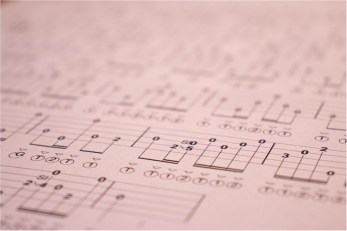
Photo of banjo tablature

And that brings me to my point:

I’m offering online banjo lessons now. That’s in addition to the usual in-person banjo lessons, of course. Normally I use Zoom, but MS Teams works and I’m pretty sure Skype would work just as well too. Lessons (both in-person and online) are on Mondays, Wednesdays and Thursdays after 5:30 or so.

Posted in Teaching | Tagged , , | 1 Comment

Learning the banjo (again) after a stroke – Part 3

Part 1 Part 2

So it was time to begin a rehabilitation process that I have described as both the most maddening and frustrating thing I have ever done (or ever will do, I’m confident), and yet also the most natural thing that has ever occurred to me. I know those are totally contradictory concepts. I cannot explain it any better. In preparation for an eventual return home, my friend and fellow banjo player Bruce talked about the need to build a front door ramp for me. I agreed that it was now needed. By this time, I knew of many hundreds of people who were praying for me. I am convinced of the efficacy of all those prayers to Jehovah-Jira, our God who provides.

After completing both occupational therapy (your arms and hands, basically) and physical therapy (your legs) I was still way off from being able to do much more than bring my left hand up to the banjo neck, Forget about being able to even remotely place my fingers where chords were formed, much less being able to make a descent-sounding chord. I have a short video of me trying to ‘play’ during this time; maybe I’ll post it along with later attempts.

Next was diligent visits to the gym and a lot of frustrating practice with trying to form chords. Two things really helped here:

1 – Lifting weights. My progress really started to accelerate as I gained muscle strength. I had lost some 20 or 25 pounds during my hospital and rehab stay. Most of that was muscle mass due to non-use of the muscles. I would work out for up to 1 1/2 hours three times per week.

2 – Serious and frustrating practice at forming chords. I used the techniques I had so often taught my own students on how to make progress in quickly forming chords. I mentally knew everything needed to play the banjo, I just needed to physically train myself again. In essence, I became my own student. My chemistry professor in college used to remind us that the first five letters in laboratory are “LABOR”. I thought the same mindset was needed here. I was right. And looking forward, this is exactly what my students need as well, especially those students who seem to be struggling with the basics. Too often we (all of us) tend to identify practicing fretted instruments as sitting on the front porch, effortlessly and leisurely picking a tune. Practice, for all of us, could not be further from that vision, as pleasant as it it to think of and anticipate.

Practice should be tough, critical, extremely repetitious, and sometimes even frustrating.

Such difficult lessons-learned in learning to play the banjo again have taught me much about the perspective of absolute beginners to fretted instruments. It has given me a new awareness of how beginners approach learning music, plus where and how exactly to apply their existing talents in order to achieve success with their musical goals and their life goals.

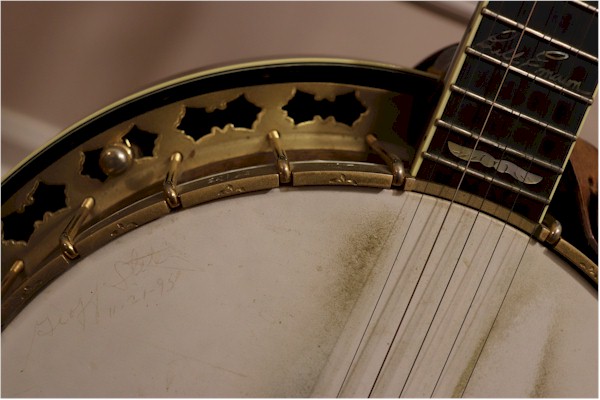
Stelling Red Fox Banjo

I should mention that even though I have recovered to a great extent, I have never been able to put in the time to get back the ability to play at the same speed, or play that ‘fancy stuff’ again. Although I’m pretty sure that only other banjo players can really tell the difference. If I didn’t have a ‘life’ then maybe I would have the time to get everything back. I do believe that it is possible, but it is very much like someone who is absolutely new with a skill; it simply takes a lot of time; time that is concentrated, long-term, laborious and sometimes even frustrating. Do you sense a trend here?

In retrospect, how I wish once again that the present-day me could have visited then; an apparition from the future. How it would have lifted my spirits to hear that not only would I recover, but I would again get to ride bikes with my son along Aldridge Creek. I would get to play the banjo again before hundreds of people on multiple occasions. I would get to continue teaching the banjo. And I would not only be able to walk again but would even become a volunteer with the Land Trust of North Alabama, building and maintaining trails for them and leading workday projects mainly on Green Mountain in the hollow where I had spent many a happy childhood day. And I would even be honored by them four years later as a 2018 Volunteer of the Year – and later, an even greater honor of having a trail named after me! All this lay ahead of me. But I could not see it.

So where do I go from here? Life has settled into pretty much the same as before. I really don’t like the phrase ‘the new normal’ as it seems to imply a certain resignation that I am unwilling to accept. I have been teaching banjo again since about 6 months after the stroke. I don’t teach mandolin or guitar anymore, and I’m fairly sure I won’t be expanding my repertoire of instruments played and taught after my retirement in a few years. But I may bring teaching mandolin and guitar back when I retire.

I’m also seeing several new or renewed interests blossom these days. I plan to expand my topic areas in this blog. I continue to enjoy volunteer work with the Land Trust, where the biggest challenges there are more age-related than stroke-related. Photography, one of my older interests, seems to have taken on a new life with me these days. Writing, theology, and urban studies are alive and well. Oh yes, then there’s birding.. and don’t forget astronomy … I also have to mention… and also don’t forget about…

You get the idea. My old self as always.

Posted in Philosophical Ramblings | Tagged , , | 6 Comments

Learning the banjo (again) after a stroke – Part 2

Part 1 Part 3

It was now almost 11 am. 2 1/2 hours since 8:20 am and my thoughts of making a cup of coffee. As soon as the clot was found, TCP was administered. Almost immediately, I felt my left side come back to life! This was great! I thought I would maybe even go back to work – now let’s figure what’s for lunch…

But it wasn’t to be quite so simple as that. After a few minutes, I felt things gradually going back to a state of paralysis again. And there they would stay, perhaps for the rest of my life. Or… perhaps not, but I could not see that at the time. Over the next few days, life seemed to be coming to a very practical close for me. I was only eking out a mere existence now, for who knows how long.

The next few weeks were difficult times, filled with despair. Nights were especially difficult. Up until this event, I had always had a good feeling thinking of hospitals, a sense of security in knowing how close I would be, if ever I were a patient in one, to the latest and the best care I could get.

I now realized I needed a new word in my vocabulary. A word that would accurately yet succinctly describe that thought and feeling (it’s both) of when your perceptions of an ideal situation are dashed against a harsh reality. I have had that happen maybe two or three other times in life, but not until this time did I really connect them as passages in life that everyone must go through. Hopefully, coming out all the wiser on the other side – yes, hopefully.

In reality, being aware of the latest medical technology was not the comfort I had envisioned. Nor was being fairly close to others. Instead, I was simply a number (I believe I was number 217, as in “Have you woke up 217 yet? Well go do it!”) I now understood what others had described to me in times past.

One very odd positive note in all this – I now laughed. A lot! If something was truly funny, I simply had to laugh out loud. And many things had a new face, and a new curiosity about them, often causing laughter. I think I laughed more in the first year after my stroke that I had in the previous ten.

Still, I had no idea what the future held now. How well would I respond to rehabilitation? No doctor nor rehab specialist could – or would – answer that. There was only a quiet resignation to either despair or the unknown.

Stelling Red Fox Banjo

Perhaps it would have been fitting for the future-me to tell the stroke-laden-me that the outcome of the arduous process that lay ahead would really be up to me and my willingness to fight. It’s true that the first thing I thought of after realizing that I was having a stroke was “I won’t be able to play the banjo anymore!” And I think that was a large part of my willingness to try to the point of total frustration to try to get back my life and my ability to play the banjo.

I remembered that day in college when I heard Tim Alexander playing “Flint Hill Special” in the band named Pickin’ Apples. That’s when I said to myself “I have no idea what it involves, but I’m going to do whatever it takes to learn the banjo!”

It was that time again.

Continued in Part 3

Posted in Philosophical Ramblings | Tagged , , | 2 Comments

Learning the banjo (again) after a stroke – Part 1

I’ve not written about this anywhere until now. Some of you know exactly what I’m talking about without another word. Others have no idea what has been going on over the past several years. I know it’s long over due, so here goes.

Friday morning, April 18th, 2014 I went to work as usual. At 8:20 am, I was just making my to-do list for the day, as is my habit. Maybe I’ll make a pot of coffee in a minute, I thought to myself. I opened the drawer to make sure I had some coffee. Great! I have some freshly ground from The Kaffeeklatsch downtown; now to go get water… Just then, I felt dizzy; so dizzy, yet not like I was losing my balance. Dizzy in a new, unusual way. Maybe 20 seconds went by. I then tried to put my to-do list in my shirt pocket, but my left hand wouldn’t make it there. It simply wouldn’t respond. My brain did not know where my left hand was! That’s when I knew what was happening.

I was having a stroke.

You’ve heard people say how your life flashes before you in times of great peril; how, in a fraction of a second, you make overarching judgments of your life’s worth and value. Is this the end? Am I really prepared to meet God?  Will it get any worse in a few seconds? What sort of pain and suffering will I encounter? That, combined with a sudden, almost existential, realization of everything minute and trivial surrounding you: is this really happening? To me? How? Why?! No!!!

True to descriptions, this thought process played out over the next one or two seconds, with reverberations of the same over the next ten seconds or so.

Stelling Red Fox Banjo

Then back to the reality of the moment: I needed help, but I was at work with no one especially close by. It was still a quiet Friday morning. My boss and only co-worker were in DC; only the people working a different contract were out in the rest of our wing of the building. But I couldn’t walk! I tried calling out, as best I could but to no avail – all use of the left side of my body, including much of my ability to talk was now gone.

Well, I had to do something. I thought of the absurdity of me staying at my desk all day until it was time to go home, as if that would fix anything. I did finally manage to scoot along the wall over to where Dorian was sitting in her cubicle.

“Hey Dorian… I’m fine, how are you? Umm…actually I’m not ok. Hey listen, I don’t mean to scare you or anything… but I’m having a stroke…”

Immediately, she and Jason helped me back to my desk, where we discussed the next step. It only took a minute to see we needed to call 911. I broke out in a cold sweat, the only real discomfort during that whole process. It seemed like a mere 10 seconds until I heard the paramedics approaching; a mere 10 minutes it seemed until I was tracing out the labyrinthine ceiling tiles of Huntsville Hospital, hoping for some odd reason to be able to remember my way out. As it turned out, finding my way out wouldn’t be necessary for quite a while.

After being wheeled into the neurological area of the emergency room, I was prepped for an MRI, or maybe it was a CAT scan. I have forgotten which came first. About this time, my wife and children arrived. Dorian had called them on my cell phone back at the office.

The first test didn’t find anything. It was obvious I was having a stroke but was it ischemic or hemorrhagic? The treatment is exactly the opposite for each, with potentially fatal consequences if misapplied. Time was wasting, though. If the stroke was being caused by a blood clot blockage – an ischemic stroke – then the application of the drug TCP within the first 3 hours or so could help tremendously in reversing the effects of the stroke. The results from the second test came back quickly – the CAT scan, maybe – I wasn’t terribly concerned about what it was called. It revealed that a tiny clot, too tiny for the first test to detect, had been found in a most critical location: my basal ganglion.

To be continued…

Part 2 Part 3

Posted in Philosophical Ramblings | Tagged , , | 2 Comments

Playing at Berkeley Bob’s in Cullman this Saturday

If you happen to be around Cullman this Saturday, drop by; several of us are playing Bluegrass at Berkeley Bob’s Coffee House at 1pm, Saturday, September 7th, 2013. It’s at 304 1st Avenue Southeast, Cullman, AL.

Actually, we are ‘practicing in public’ for a bluegrass wedding we are providing music for in October. At any rate, it should be a fun time; come on out!

Posted in Venues | Tagged , , | 1 Comment

Solid Blue at The Flying Monkey

I know this is sort of late notice – it’s this evening – but my friends Cindy Musselwhite, Bud Teague and company (Solid Blue is the band’s name) are playing at The Flying Monkey tonight. Check ’em out!

http://www.lowemill.net/ai1ec_event/solid-blue-bluegrass-band-with-cindy-musselwhite/?instance_id=86535

Posted in Venues | Tagged , , | Leave a comment

Why is the Banjo so Mysterious?

I must declare here: the banjo is a thoroughly fascinating thing.  Whether playing Bluegrass, Old-Time, Folk, Jazz, or any other genre, it has a certain fascination, even a mystery, about it. And not only in sound, but in looks as well. Karen Lynn has described the sound as a ‘half-barbaric twang’ in her excellent, scholarly book by the same phrase.

But the intrigue goes beyond simply auditory and visual aspects of an odd object. There’s something more that makes the banjo a mysterious thing. Many people have stated that this is the main thing that attracted them to wanting to play the banjo, thus starting their relationship with me, also. My students and I have long discussed some of these. Here, I’d like to recall and assemble all the talking points on why the mystique surrounding the banjo.

I’ve categorized these points roughly as I have in several other blogs dealing with various qualities of our instrument: Visual, Auditory, and, in this case, Other.

1. Visual
That 5th string half way up the neck. Supposedly added by a Mr Joel Sweeney in 1836, although there are now historical indications it was added much earlier.

Nevertheless, no other American instrument has this 5th string; although other, exotic instruments in the world have something similar. These other instruments with sympathetic strings only serve to reinforce an alternate, exotic appearance in the banjo.

It’s a visually complex instrument. Often, it also has various ‘frills’, such as inlays (more than you typically see on either a guitar or mandolin), extra carvings (such as on the heel, neck or resonator) and peghead ornamentation. Having a drum, it also has lugs for tensioning the drum head, adding to the complex look.

2. Auditory
Rolls. Created with the advent of Scruggs style, rolls may be 3, 4 or more notes in length before repeating. Since these rolls are played with the thumb, index and middle fingers, different fingers will take lead notes in a manner that is undecipherable to someone who doesn’t play an instrument in finger- picking style (Scruggs style banjo, Cross picking a mandolin or guitar, or Chet Atkins style guitar, for instance).

3-finger rolls in 2/4 and 4/4 time. Here’s where syncopation starts to enter the picture. Three note rolls, repeated within a 2 or 4 beat measure makes for an off-kilter effect that is harder for our brains to process.

The 5th string is used as a drone. In the dominant style, Scruggs style, the 5th string is never fretted, giving it an almost subconscious root note. Once again, this is unique in American music.

These 3 points above are interrelated: a syncopated roll that may or may not be off-kilter, with an occasional drone note that comes out of nowhere. Add to that the fact that we usually think of notes coming from an acoustic instrument by means of a flat pick as opposed to the actual process of finger picking; no wonder our brains cannot decompile the process of playing a banjo.

There are strings stretched across a drumhead. This is the fundamental definition of a banjo. This is what gives it that signature ‘twang’. Even if you take another instrument, such as a mandolin or dulcimer, and place a drum head in the body, the sound becomes more that of a banjo than whatever the other instrument was.

Quick decay of the tone. Inherent in the basic physics of the aforementioned string across a drumhead; our ears define that characteristic banjo sound as also having a quick decay, giving it that plunky effect. Interestingly, if you increase the mass of the object separating the string from the drumhead (the bridge) it will increase the sustain of the note, giving the banjo a considerably different sound.

3. Other
You’ve heard the saying about the whole being greater than the sum of the parts? That metaphor fits logically here as well.

The Banjo’s rural background. Like all things rural, there is no slick marketing. If it is worth something, go find it yourself. And don’t spoil the secret by telling everyone on Earth, either – just tell your neighbor.

Perception of being on the ‘wrong side of the tracks’. Ever since the days when the banjo was associated with plantations, slaves and minstrel music, it has been perceived of as less-than-ideal. That personality has stuck with the banjo even to this day, despite having changed hands into different ‘owners’ several times. Owners have included slaves, minstrel performers, young ladies of proper upbringing who wished to rebel against Victorian society, the isolated rural population in general, hippies, and now practitioners of Bluegrass; what a motley crew!

Perceived simplicity. Especially true of the older styles of playing, before Mr. Scruggs, conjuring up images of the ‘Old South’. A simplicity that is still enthusiastically embraced by many. This is a paradox, I’ll admit. How can an instrument be both undecipherable and at the same time simple? And yet that is the perception many of us have of it.

Multiplicity of tunings. Some of which are very distinct: modal tunings, minor tunings and such. Few instruments have such a wealth of tunings. Quite frankly, as I sit here I can’t think of another instrument that approaches the banjo in terms of the richness of tunings; traditional or modern.

History. History is closely integrated into many of the points as stated above, but there is one more point to be made in regard to history. The recent history of the banjo is fairly well known. It came over from Africa with slaves and modifications have been made to it since that time to the extent that the original Banjar, or Akonting, or whatever came over here, is a very different instrument from the modern day bluegrass banjo. The banjo was not of European ancestry, as many other instruments were. Indeed, it was perhaps brought to Africa from the Middle East centuries before its journey to America. Were the sitar and sarod also ancestors to the banjo? In short, We know just enough history to allow for imagination to fill in the rest of the details.

I hope you’ve found these points as fascinating as I have in compiling them!
Posted in Banjos and Society, History, Philosophical Ramblings | Tagged , , , , , , , , , , , , , , | 2 Comments

The Deep Ellum Banjo Man

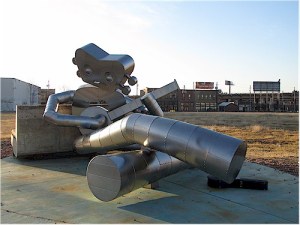
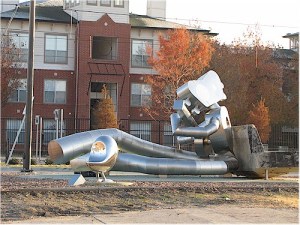
Back in December of 2009, I travelled to Denton, Texas to watch my oldest daughter Paige graduate from the University of North Texas. We had a grand time there, especially on the Denton County Courthouse square, with all the touristy type stores decked out for Christmas. And that used bookstore! You see, Denton, like many small Texas towns, had a opera house on the Square ages ago. This one, like all similar opera houses in Texas I know of, had fallen into disrepair. So it was converted into, at present, a huge bookstore. What a wonderful place to browse in!

Anyway, I digress.

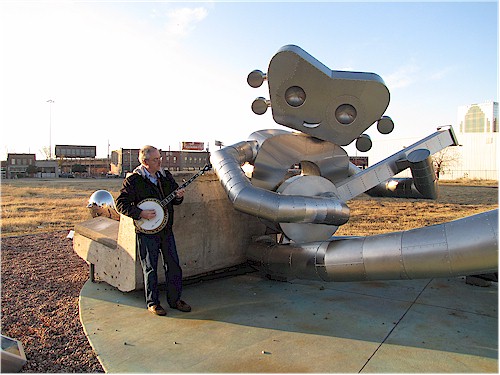
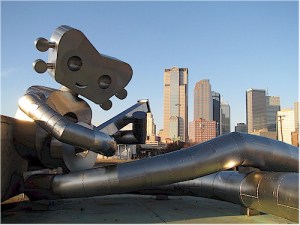
I had also heard that there was a very interesting street sculpture just east of downtown Dallas of a banjo man. Armed with information from the Internet, I set out to find him on Me and My New Pickin' Buddythe way back, and sure enough, there he sat in the Deep Ellum District at the southwest corner of North Good Latimer and Gaston Avenue. Quite an imposing figure, I have a few photos of him here, along with yours truly picking a number with him.

The Deep Ellum district in Dallas was once a famous venue for Blues musicians. It appears its renown has diminished in recent decades, though.The Banjo Man, with Downtown Dallas in the Background BanjoManDallas3

Compare these small trees in front of the building with what is current on Google Streetview.And alas, when I went to Google street view just now, the Banjoman is barely seen on the higher-altitude view, but in the street view (seemingly newer as the trees are bigger), it appears that some construction is going on at that corner. Could it be he has been removed?

There is another similar ‘tinman’ elsewhere in Deep Ellum, two blocks northwest at Good Latimer and Miranda Street; this fellow appears to be a singer, not a banjo player.

Click on these images for a slightly larger photo.

Posted in Banjos and Society, History | Tagged , , , , , | 2 Comments

Getting Good Feedback

As you progress in playing the banjo, your skill level will increase. Simple enough. But realize that that increase in skill level doesn’t come just as a result of your having practiced for a long time. You also need feedback; something that will tell you when you are going wrong. And it should tell you early in the process so you don’t have to relearn any more than is necessary.

Feedback, as Dictionary.com (http://dictionary.reference.com/browse/feedback?s=t) defines it, is “knowledge of the results of any behavior, considered as influencing or modifying further performance”. Good feedback is anything that helps you improve your playing by successfully delivering on this definition.

Feedback can be categorized as Auditory, Tactile, or Visual. No, smell doesn’t count.

Auditory:  This includes Pitch, Timbre, Volume, Intonation, or Rhythm as sources of feedback.

Types here are recordings of your playing, listening to yourself live (the least effective, BTW), or a metronome. Any one of these could be areas for improvement, but some can be very tricky to even find a clue that you are off.

I had a problem with this when I first started playing the banjo. I didn’t realize that my timing was too variable. (Yes, you can vary your timing, just a little (playing ahead or playing behind it’s called), but that is purposeful, and very little is needed for the effect; I’m talking about the much more common pitfall of simply having bad timing.) I didn’t realize I had it until I heard myself on a recording, then I knew what to do (get a metronome and use it on a regular basis). It was just a matter of knowing what the problem was in the first place.

Tactile: Fretting fingers, picking fingers and hand, and to a lesser extent, you arms and shoulders. The most overlooked source of information, especially in the tips of the fretting fingers. Train yourself to listen to what your fingers are telling you. Pay attention to the following.

What your fretting hand is telling you:
1) I’m exerting pressure on the fretboard with my fingers
2) There is a wire between my finger & the fretboard
3) I’m also touching something like a wire on the side
4) I’m stretching that wire underneath (up or down)
5) I’m touching a fret (purposefully beneath or accidentally on the side)

Traing yourself to be aware of each of these fretting hand signals above.

6) Your calluses. Don’t have any? Then you probably aren’t getting enough practice! BTW, too much water on your hands causes calluses to not form as easily and to go away quicker.

What your picking hand is saying:
1) picks too loose or they fall off easily. Get a pair of needle-nose pliers and spend 10 minutes adjusting them. Get all the ‘air pockets’ out; the space between your fingers and the picks, so that there is almost total contact with your fingers. Make sure they are tight enough as well.
2) Picking is too forceful – lighten up and find how smooth and gracefully you can play
3) Picking is too soft – play with confidence! It will sound so much better.
4) Aching hands and fingers. A certain amount of this is inevitable in learning something new, but soon (just like with riding a bike, or lifting weights, etc.), this should go away. If it is still a problem, make sure you aren’t holding your hand in an unnatural position. Here’s where an instructor can really help out.

Your arms and shoulders: Same thing here in terms of unforeseen stresses and strains. Make sure everything is in a natural position and comfortable.

Also, you should know that good quality modern bluegrass banjos are, literally, THE heaviest stringed instruments that you actually pick up (yes, an upright bass is heavier; thankfully it sits on the floor!). If you aren’t used to holding one while standing for long periods of time, then your back and shoulders are probably going to get strained. Gradually get used to it by standing more and more as you practice.

Visual: A lot of this category overlaps with others (auditory and tactile). I think we have covered them well enough above. These include:
1) Metronome
2) Positions of hands and fingers
3) Stance and posture, etc.

In addition, different kinds of feedback may be from yourself (that is, your own eyes, ears and fingers), or from others (an Instructor or other person).

Just remember these points in closing:
1) Anything you can detect or know can be considered feedback
2) Almost all feedback can be helpful
3) Any gained feedback requires a response in order to be put to effective use
4) That response must be positive

Posted in Tips & Techniques | Tagged , , , , , | Leave a comment

The Spam I Get

This is actually quite funny. I get these sort of emails every month or so. Obviously these are spam at best; phishing attempts  in a worse scenario. These are email requests I get from my website, because one of my email aliases is out there for people to contact me.

Today, I’d like to share some of these ridiculous-to-the-point-of-being-funny spams I have gotten requesting “music lessons”! As you can see, the spelling and grammar are dead give-aways. When they don’t ever mention a banjo or mandolin (they just say ‘instrument’) you also know.

More often than not, the theme is that their son or daughter (typically 14 years old) is coming to the states and they want to know you instrument (duh!), rates, availability, etc.

Read on for a few classic examples. I’ve included a few comments with <> brackets.

#1 This is a typical theme. A teenage son or daughter. Coming to the states. Bad grammar. This one also refers to the son named John as ‘she’.

Hello,
How are you today?
I got your contact email while searching for Music and dance teacher on the internet. I have a son (John) who is interested studying music. John doesn’t have any previous in the instrument but he is ready to learn. She’s 15 year old with very sharp brain <well, that’s good, because ‘she’ sure didn’t get it from dear ‘ol dad :)>
If you will agreed to accept John as your student,please get back to me with the following information..
Total fees for one months lessons(Two hours lessons in a week)?
Your teaching location and phone number?
The instrument you teach?

I want the lessons to start by 5th of November.

PLEASE DONT REPLY ME IF YOU ARE UNAVAILABLE TEACHER.   Looking forward to hear from you.

#2

Hello,

I will like to know if you have available slots/times to teach my son for lesson 3 time a week. It will be useful if you could get back to me with your area of Expertize/Specialization and also your charges.
Expecting to hear from you soon so as possible to proceed with the arrangement.

Mrs <American-sounding name was here>

#3 This kind is interesting as they actually state some banjo-related information upfront. Horrible spelling, though; you know it did a number on my WordPress spell checker. From looking at the To: line in the email, it was also sent to many other banjo teachers, several being friends of mine. An obvious spam.

hello my name is will liams amd from uk, i saw your advert on www.banjoteacher.com and i want you to teach my son who is cooming down to Alabama for holiday how to play guiter or any thumb style rhythm guitar orScruggs, so i will like to hear from you soon..you can contact me at  <a Yahoo email here>
thanks

I wonder – how many successful phishing attempts come about from such emails? I don’t get enough to be annoying; maybe one a month. Still, it is amazing that people still propagate such stuff.

Needless to say, I did NOT respond to any of these!

Posted in Banjos & Technology | Tagged , , | 1 Comment